In the early days of SEO, ranking on Google was a numbers game. If you repeated a keyword enough times and built enough backlinks, you could practically force your way to the top. However, as we move through 2026, the game has undergone a fundamental change.
Today, Google doesn’t just look at what people are typing; it looks at why they are typing it. This “why” is known as Search Intent. If your content doesn’t align with the user’s underlying goal, all the technical optimization in the world won’t save your rankings.
In this comprehensive guide, we will break down the different types of search intent and explain why mastering this concept is the single most important factor for SEO success today.
What Is Search Intent?
Search intent (also known as user intent) is the primary goal or reason behind a user’s search query. It represents the “missing link” between a keyword and a satisfied user.
When someone opens a search engine, they usually have a specific need:
-
They want to learn something.
-
They want to go to a specific website.
-
They want to buy a product.
-
They want to compare options before deciding.
Google’s mission is to organize the world’s information and make it universally accessible and useful. To stay “useful,” Google must provide the most relevant results. If a user searches for “how to bake a cake” and Google shows them a “Buy Cake Now” sales page, the user will be frustrated. By understanding intent, Google ensures the results match the expectation.
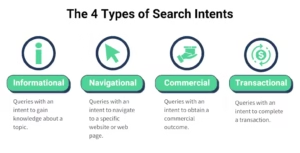
The 4 Core Types of Search Intent
To optimize your content effectively, you must first understand the four traditional categories of search intent.
1. Informational Intent
The user is looking for specific information or an answer to a question. These users are in the “discovery” phase.
-
Common Modifiers: How to, what is, history of, guide, tips.
-
Examples: “What is search intent?”, “How to plant tomatoes,” “SEO trends 2026.”
-
Best Content Format: Blog posts, “how-to” guides, whitepapers, and infographics.
2. Navigational Intent
The user is looking for a specific website or brand. They already know where they want to go but find it easier to search than to type the full URL.
-
Common Modifiers: Login, official site, contact, [Brand Name].
-
Examples: “Facebook login,” “Semrush blog,” “Nike customer service.”
-
Best Content Format: Homepage, login pages, and brand-specific landing pages.
3. Commercial Intent
The user is in the market for a product or service but hasn’t made a final decision. They are researching and comparing their options.
-
Common Modifiers: Best, top, vs, review, comparison.
-
Examples: “Best SEO tools 2026,” “iPhone vs Samsung,” “Top-rated coffee makers.”
-
Best Content Format: Comparison tables, listicles, product reviews, and case studies.
4. Transactional Intent
The user is ready to buy. They have finished their research and are looking for the right place to complete the transaction.
-
Common Modifiers: Buy, price, discount, coupon, for sale.
-
Examples: “Buy iPhone 15 Pro,” “Bluehost discount code,” “Order pizza online.”
-
Best Content Format: Product pages, pricing pages, and checkout landing pages.
Why Search Intent Matters for SEO in 2026
If you ignore search intent, you are essentially fighting against Google’s algorithm. Here is why it is critical for your strategy:
1. Improved Rankings and Visibility
Google’s RankBrain and AI-driven algorithms (like the latest 2026 updates) prioritize pages that satisfy the user’s query. If users click your result and immediately “bounce” back to the search page because you didn’t answer their question, Google interprets this as a signal that your content is not relevant. High intent alignment leads to better dwell time and higher rankings.
2. Higher Conversion Rates
By matching your content to the user’s stage in the buyer’s journey, you increase the likelihood of conversion. If you target a “Transactional” keyword with an “Informational” blog post, you won’t get sales. Conversely, if you provide a helpful guide to someone with “Commercial” intent, you build the trust necessary to convert them later.
3. Better User Experience (UX)
Understanding intent allows you to structure your page for the user’s needs. If someone wants a quick answer (Informational), use a summary or a bulleted list at the top. If they want to compare (Commercial), use a comparison table. Content that is easy to consume and relevant creates a positive brand experience.
How to Optimize Your Content for Search Intent
Optimizing for intent requires a shift from “keyword-first” to “audience-first” thinking. Follow these steps to ensure your content ranks:
Step 1: Analyze the SERP (Search Engine Results Page)
The easiest way to know what Google thinks the intent is for a keyword is to look at the current top 10 results.
-
If the top results are all videos, create a video.
-
If they are all listicles, write a listicle.
-
If they are product pages, don’t try to rank with a long blog post.
Step 2: Use the “Three Cs” of Search Intent
-
Content Type: Is it a blog post, product page, landing page, or video?
-
Content Format: Is it a tutorial, a list, a comparison, or a news opinion piece?
-
Content Angle: What is the specific “hook”? (e.g., “for beginners,” “free,” or “in 2026”).
Step 3: Address “People Also Ask” (PAA)
Google’s PAA boxes are a goldmine for understanding the nuances of user intent. By answering these related questions within your content, you cover the topic more comprehensively and increase your chances of appearing in AI Overviews.
Frequently Asked Questions (FAQs)
1. Can a single keyword have multiple search intents?
Yes. This is known as “Fractured Intent” or mixed intent. For example, the keyword “log cabin” could mean someone wants to see photos (informational), buy one (transactional), or find a specific brand (navigational). In these cases, Google usually shows a variety of content types on the first page.
2. How often should I re-evaluate search intent for my keywords?
Search intent can shift over time. For example, during a product launch, a keyword might be informational (news), but a year later, it might become transactional (buying). It is a best practice to audit your top-performing pages every 3–6 months to ensure they still align with the current SERP landscape.
3. Does AI-generated content help with search intent?
AI can help you outline and draft content, but it often lacks the “Experience” and “Expertise” (E-E-A-T) that Google looks for in 2026. To truly satisfy intent, you must add unique insights, real-world data, and a human perspective that AI cannot replicate.
Invest in Comprehensive SEO Services to Optimize Specific User Intent
Understanding search intent is one thing, but executing a strategy that covers thousands of keywords requires professional expertise. If you are looking for detailed assistance in streamlining your SEO services and want dedicated support to optimize your business for specific user intent, then eMarketters is the right place to be.
As a leading SEO company in Lucknow, we offer comprehensive SEO support, customized packages, and flexible, sure-shot user intent optimization services, all competitively priced. We don’t just target keywords; we target the “why” behind the search to ensure your traffic actually converts. Connect with us at eMarketters.com to explore tailored business opportunities and take your digital presence to the next level!