Artificial Intelligence has changed how people search online. Instead of typing keywords into search engines, users now ask questions to AI assistants like ChatGPT, Gemini, Claude, and Copilot. These tools provide direct answers rather than simply displaying a list of websites.
Many businesses assume that AI has replaced SEO. In reality, the opposite is true.
If your website isn’t optimized for search engines, there’s a strong chance AI systems won’t discover, trust, or recommend your content either. That’s why the phrase “No SEO. No AI Visibility. It’s That Simple.” is becoming increasingly accurate.
Whether you own a local business, an eCommerce store, or a service company, investing in SEO remains the foundation of digital visibility. A trusted SEO company in Lucknow understands that modern optimization isn’t just about ranking on Google anymore—it’s about becoming a trusted source for AI-generated answers as well.
What Does AI Visibility Actually Mean?
AI visibility refers to your website being recognized, understood, and cited by Large Language Models (LLMs) when users ask relevant questions.
Instead of clicking through multiple websites, users often receive AI-generated summaries. Those summaries are created using trusted and well-structured online information.
If your content is missing from that ecosystem, your business becomes invisible—even if you have an attractive website.
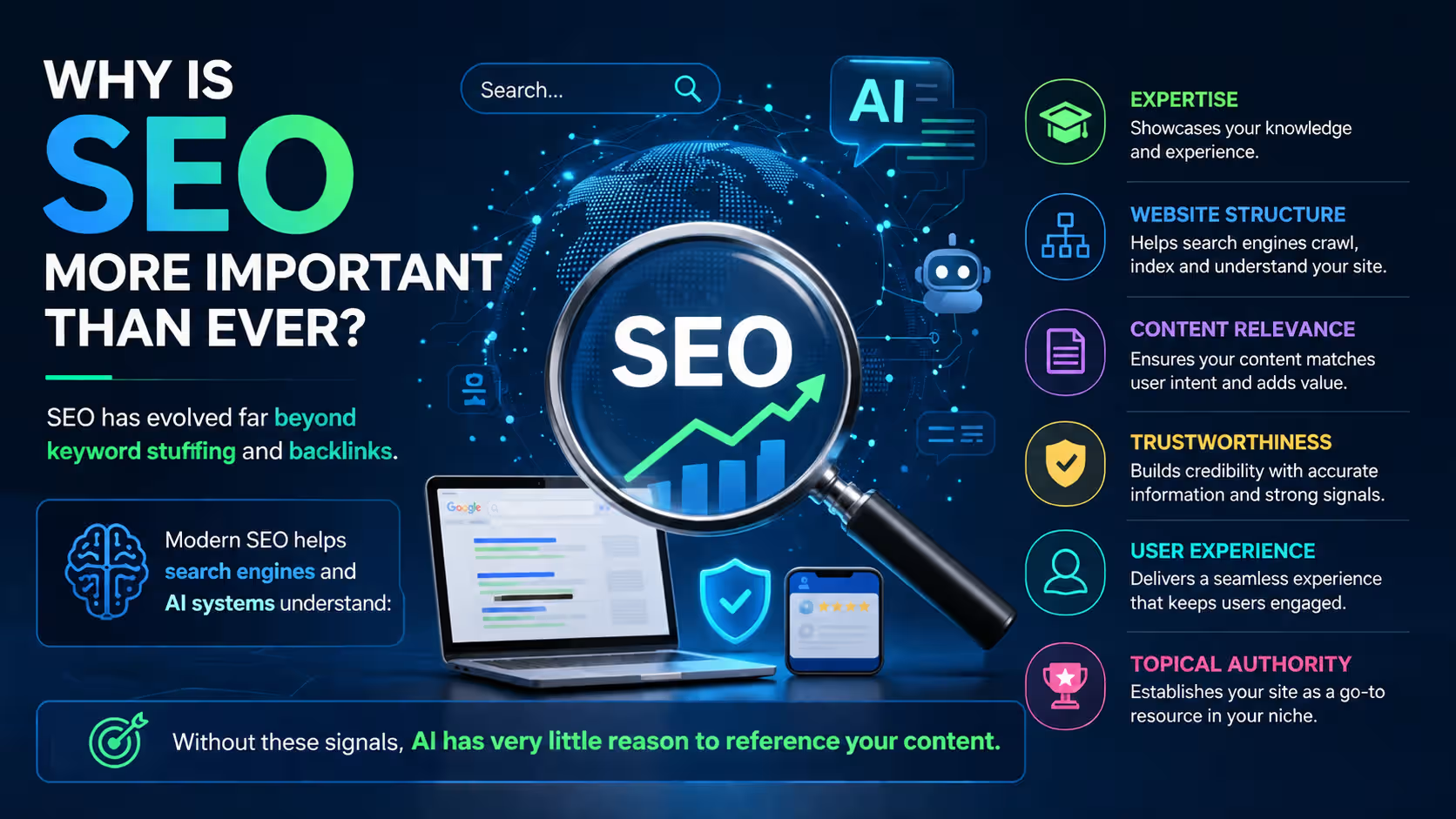
Why Is SEO More Important Than Ever?
SEO has evolved far beyond keyword stuffing and backlinks.
Modern SEO helps search engines and AI systems understand:
- Your business expertise
- Website structure
- Content relevance
- Trustworthiness
- User experience
- Topical authority
Without these signals, AI has very little reason to reference your content.
How Do AI Search Engines Find Your Content?
Large Language Models don’t magically know everything.
Most AI-powered search systems rely on several signals, including:
- Search engine indexes
- Authoritative websites
- Structured content
- Fresh information
- High-quality backlinks
- Schema markup
- Entity recognition
- User engagement signals
SEO builds these foundations.
Why Doesn’t AI Recommend Every Website?
AI aims to reduce misinformation.
When multiple websites discuss the same topic, AI tends to prefer sources that demonstrate:
- Expertise
- Experience
- Accuracy
- Clear content structure
- Consistent publishing
- Strong online reputation
These are exactly the same principles that good SEO focuses on.
LLMs Predict & Ground
Large Language Models operate using two important concepts:
Prediction
LLMs predict the next most likely words based on patterns learned during training. This allows them to generate natural, human-like responses.
Grounding
Prediction alone isn’t enough for accurate answers.
Modern AI systems increasingly “ground” their responses using trusted external information, recent web content, authoritative websites, and structured data. Grounding improves factual accuracy and helps AI provide reliable recommendations.
This is where SEO becomes essential.
A website with:
- Organized content
- Strong topical authority
- Clear headings
- Helpful answers
- Technical optimization
- Structured data
is far more likely to become part of the information AI systems use for grounded responses.
Can AI Understand Poorly Optimized Websites?
Sometimes—but not consistently.
Problems like:
- Slow-loading pages
- Broken links
- Thin content
- Duplicate pages
- Missing headings
- Poor internal linking
- Lack of schema
make it harder for both search engines and AI systems to interpret your content.
Good SEO removes these barriers.
Can You Optimize For LLMs Without An SEO Program?
The short answer is No.
There is currently no separate “AI optimization” strategy that replaces SEO.
Instead, LLM optimization builds on strong SEO practices.
If your website already focuses on:
- Helpful content
- Clear information architecture
- Technical SEO
- Structured data
- Topical authority
- Fast performance
- User experience
then you’re already improving your chances of appearing in AI-generated responses.
Businesses looking for long-term online growth often work with a Digital Marketing agency in Lucknow like eMarketters to build a sustainable SEO strategy that supports both traditional search engines and emerging AI platforms.
How Can You Improve AI Visibility?
Create Content That Answers Real Questions
AI favors content that directly solves user problems instead of focusing only on promotional messaging.
Build Topical Authority
Publishing multiple in-depth articles around one subject helps establish your website as a trusted resource.
Use Clear Content Structure
Well-organized headings, bullet points, tables, and FAQs make information easier for both users and AI systems to understand.
Improve Technical SEO
Ensure your website has:
- Mobile responsiveness
- Fast loading speed
- HTTPS security
- Clean URLs
- XML sitemap
- Schema markup
Earn Quality Backlinks
Links from trusted websites continue to signal credibility and authority.
Keep Content Updated
Fresh content increases the likelihood that AI systems will treat your information as relevant and reliable.
Is Ranking #1 on Google Enough?
Not always.
AI assistants often summarize information from multiple trusted sources instead of relying on a single top-ranking webpage.
This means businesses should focus on becoming an authoritative source rather than chasing rankings alone.
Why Are FAQs Becoming More Important?
AI assistants frequently answer conversational questions.
Including well-written FAQ sections helps AI understand:
- User intent
- Direct answers
- Context
- Related concepts
This increases the chances of your content being referenced.
Common SEO Mistakes That Reduce AI Visibility
Many businesses unintentionally limit their visibility by:
- Publishing thin content
- Ignoring technical SEO
- Using outdated keyword strategies
- Copying competitor articles
- Neglecting internal linking
- Skipping schema markup
- Failing to update old pages
Avoiding these mistakes strengthens both search rankings and AI discoverability.
The Future of SEO and AI
AI isn’t replacing SEO.
Instead, SEO is becoming the foundation that enables AI systems to understand, trust, and recommend your website.
Businesses that invest in high-quality content, technical optimization, and user experience today will be better positioned for the future of search.
Conclusion
As AI search continues to evolve, one fact remains unchanged: websites need strong SEO to earn visibility, trust, and recommendations.
Rather than viewing AI and SEO as competing strategies, businesses should see them as complementary. SEO provides the structure, authority, and signals that help AI understand your content, while AI-powered search creates new opportunities for brands that consistently publish helpful, reliable information.
In today’s digital landscape, the message is clear: No SEO. No AI Visibility. It’s That Simple.
Frequently Asked Questions
1. What is AI visibility in SEO?
AI visibility refers to your website being recognized, understood, and referenced by AI-powered search tools and Large Language Models when users ask relevant questions.
2. Does AI replace SEO?
No. AI does not replace SEO. Strong SEO practices improve your chances of appearing in both traditional search results and AI-generated answers.
3. What are LLMs?
Large Language Models (LLMs) are advanced AI systems trained to understand and generate human language, powering tools like ChatGPT, Gemini, Claude, and Copilot.
4. Why is structured content important for AI?
Structured content with clear headings, logical organization, and schema markup makes it easier for AI systems to understand and retrieve information accurately.
5. Can AI read every website on the internet?
Not necessarily. AI systems often rely on indexed, authoritative, and accessible sources, so websites with poor SEO may receive less visibility.
6. How does technical SEO help AI visibility?
Technical SEO improves crawlability, page speed, mobile usability, and structured data, making it easier for both search engines and AI systems to interpret your website.
7. Are backlinks still important for AI search?
Yes. High-quality backlinks remain a strong signal of authority and trust, which can indirectly improve AI visibility.
8. Should I create separate content for AI search?
No. Focus on creating accurate, well-structured, and user-focused content. Quality SEO content naturally supports AI discoverability.
9. How often should I update my website for better AI visibility?
Regularly updating content with current information, improved accuracy, and new insights helps maintain relevance for both search engines and AI systems.
10. What is the best long-term strategy for improving AI visibility?
The best approach is to combine technical SEO, authoritative content, excellent user experience, structured data, and consistent content updates to build lasting online authority.