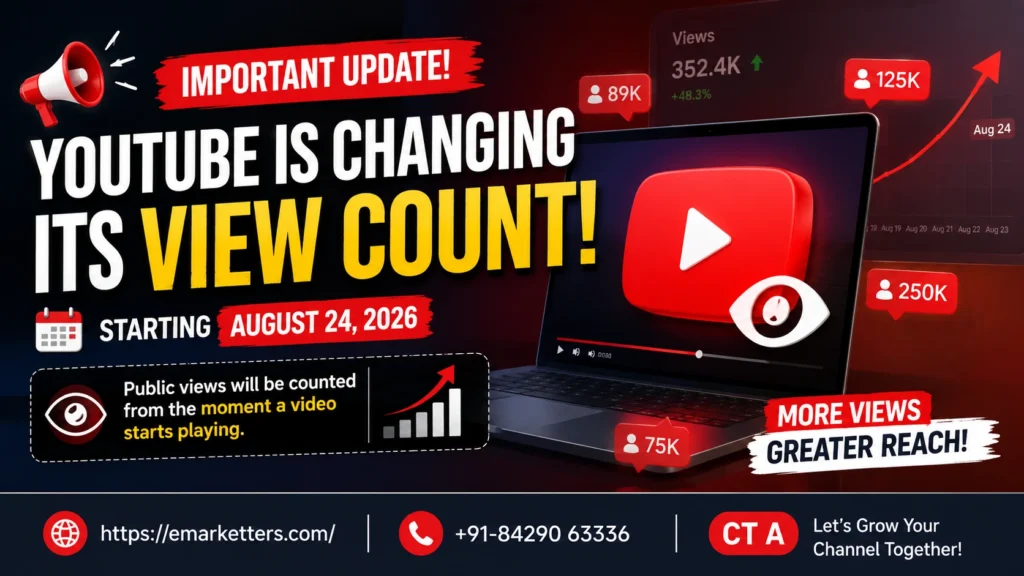
Starting August 24, 2026, YouTube is changing the way it counts public video views—and creators may soon notice bigger numbers on their videos.
For years, the view count has been one of the first things creators, brands, and viewers look at. A video with 100,000 views appears to have reached far more people than one with 10,000 views. But from August 24, the way those public views are counted is changing.
Under YouTube’s updated approach, a public view can be counted from the moment a video starts playing. This could make view counts increase faster and give creators a broader picture of how often their content is played.
But there is an important catch.
More views on the counter do not automatically mean more watch time, higher revenue, or better engagement.
So, what does this YouTube view count update actually mean, and how should creators and marketers measure their performance after the change?
What Is Changing in YouTube’s View Count?
The biggest change is simple: YouTube’s public view count will reflect video starts more directly.
In practical terms, when someone starts playing your video, that play can contribute to the public view count under the updated system.
This means creators may see view numbers grow faster than before.
Imagine that 10,000 people start watching your video. Some viewers may watch the entire video, while others may leave after a few minutes or even a few seconds.
The important point is that the public view counter is becoming a broader measure of how many times people started playing your content.
As a result, some creators could see higher public view numbers without necessarily receiving a dramatic increase in actual traffic.
This distinction is important.
If your views increase after August 24, it does not automatically mean that YouTube suddenly sent thousands of additional viewers to your channel. Part of the increase may come from the new YouTube view-counting methodology.
That is why comparing your performance before and after the update requires more context.
Will Your YouTube Videos Suddenly Get More Views?
Potentially, yes—but there is more to the story.
Because more video starts may now be reflected in the public view count, creators could notice a significant increase in visible views.
For example, imagine that your video receives 50,000 plays.
If those plays are counted differently under the updated methodology, more of them may now appear in the public view number.
However, this does not necessarily mean your audience grew overnight.
Suppose your channel receives:
- 20,000 views in August
- 35,000 views in September
At first glance, it may appear that your channel experienced massive growth.
But if the new YouTube views update affected how those views were counted, part of that increase could come from the measurement change rather than increased audience demand.
This is why creators should avoid looking at views alone.
Instead, compare several important YouTube Analytics metrics to understand whether your channel is actually reaching more people and generating stronger engagement.
More Views Do Not Always Mean Better Performance
This is probably the most important takeaway from the update.
Consider two viewers.
Viewer A watches your 15-minute video for 12 minutes.
Viewer B starts the video but leaves after a few seconds.
Both may contribute to your video’s public reach, but they clearly do not provide the same level of engagement.
That is why a high view count alone cannot tell the complete story.
Creators should continue monitoring:
- Watch time
- Average view duration
- Audience retention
- Engaged views
- Returning viewers
- Subscriber growth
- Click-through rate
- Website clicks and conversions
A video with 100,000 views may look successful, but if viewers leave almost immediately, the content could have a serious retention problem.
On the other hand, a video with 20,000 views and excellent watch time may perform extremely well because viewers are genuinely interested in the content.
Views tell you that people started watching. Engagement metrics tell you whether they actually stayed.
Why Is Watch Time Still So Important?
The YouTube algorithm is not simply about generating the biggest possible view count.
YouTube wants viewers to find content they enjoy and continue using the platform.
That is why watch time, audience retention, viewer satisfaction, and other engagement signals remain important for creators.
If your title and thumbnail convince 100,000 people to click, but most of them leave within seconds, a high public view count alone will not solve the problem.
The real goal should be:
Get the click → Deliver what you promised → Keep viewers interested → Encourage them to return.
The new view-counting system does not change this basic principle.
Creators should still focus on creating videos that answer the viewer’s question, solve a problem, entertain the audience, or provide useful information.
What Does This Mean for YouTube Shorts?
The update could help create a more consistent approach to public views across YouTube’s different content formats.
Today, YouTube includes much more than traditional videos. Creators publish:
- YouTube Shorts
- Long-form videos
- Live streams
- Podcasts
- Educational content
- Entertainment videos
Each format has different audience behaviour.
For example, Shorts are designed for fast discovery and quick consumption. A long-form video may take several minutes or even an hour to watch.
Because of this, creators should not judge every format using the same strategy.
A Short with 500,000 views may help increase awareness and discovery, while a 10-minute video with 50,000 highly engaged viewers may build stronger audience relationships and generate more watch time.
The best strategy is to understand what each type of content is designed to achieve.
Does This Mean YouTube Monetization Will Become Easier?
Not necessarily.
This is where creators need to be careful.
A higher public view count does not automatically mean higher YouTube revenue. It also does not mean creators will automatically qualify for monetization faster.
YouTube uses different metrics for different purposes.
The public number visible below a video represents one type of performance measurement. Monetization, earnings, and YouTube Partner Program eligibility can depend on additional requirements and qualified engagement metrics.
So, creators should not assume:
“If my views double, my earnings will also double.”
That is not necessarily true.
YouTube revenue can be influenced by several factors, including:
- Audience location
- Viewer behaviour
- Watch time
- Content category
- Ad availability
- Advertiser demand
- Monetization eligibility
Therefore, the new public view count should be seen as a change in how YouTube displays content reach, not as a guarantee of more income.
What Metrics Should You Track After August 24?
After the YouTube view count update, creators should look beyond the visible number below their videos.
Here are the metrics that deserve your attention.
1. Watch Time
Watch time shows how much time viewers actually spend watching your content.
If your public views increase significantly but total watch time remains almost unchanged, it could mean more people are starting your videos without staying for long.
2. Audience Retention
Audience retention helps you understand where viewers lose interest.
Pay special attention to the beginning of your video.
If viewers leave within the first 30 seconds, consider improving your opening hook, pacing, editing, or introduction.
The first few moments of a video are often critical.
3. Click-Through Rate
Your title and thumbnail are responsible for convincing people to click.
A strong click-through rate means your packaging is attracting attention.
However, a high click-through rate combined with poor retention can indicate a problem. Your title or thumbnail may be creating expectations that the video does not immediately meet.
The best videos balance both clickability and viewer satisfaction.
4. Returning Viewers
One viral video does not automatically create a successful YouTube channel.
Returning viewers are especially valuable because they show that people enjoyed your previous content enough to come back.
A loyal audience can create stronger and more sustainable growth than one-time viral traffic.
5. Subscribers and Conversions
For businesses, views are often not the final objective.
Your YouTube strategy may aim to generate:
- Subscribers
- Website traffic
- Leads
- Service bookings
- Product sales
- Brand awareness
Because of this, 10,000 highly relevant viewers may sometimes be more valuable than 100,000 random viewers.
The question is not only “How many people watched?”
It should also be:
“Did the right people watch, and did they take the action we wanted?”
What Does the Update Mean for Brands and Marketers?
The new YouTube view count update 2026 is also important for businesses, agencies, and marketers.
If you manage YouTube channels for clients, you should be careful when comparing reports from before and after August 24.
Imagine that a client’s views increase by 50%.
That sounds like excellent growth. But before presenting it as a major success, ask an important question:
What caused the increase?
It could be the result of:
- Better video content
- Improved thumbnails
- Stronger titles
- Increased audience interest
- Better promotion
- Seasonal demand
- The new view-counting methodology
In some cases, the answer may be a combination of several factors.
This is why professional YouTube reporting should include more than just total views.
A stronger report should also analyse:
- Total watch time
- Average view duration
- Audience retention
- Returning viewers
- Subscriber growth
- Traffic sources
- Website clicks
- Leads and conversions
These metrics provide a more complete picture of actual performance.
Could Higher Public Views Affect Brand Deals?
Possibly.
Public view counts are often one of the first numbers brands notice when evaluating a creator.
Higher visible view numbers could help creators demonstrate the reach of their content. However, smart brands should not choose creators based only on public views.
They should also consider:
- Average views
- Audience engagement
- Audience demographics
- Niche relevance
- Viewer behaviour
- Brand fit
- Conversion potential
A creator with 100,000 highly engaged viewers in a specific niche may be much more valuable than someone with millions of views from an unrelated audience.
The update could encourage brands to look beyond vanity metrics and focus on meaningful results.
How Should Creators Prepare for the Change?
Creators do not need to completely change their YouTube strategy.
Instead, they need to understand their data more carefully.
First, keep track of your existing channel performance before August 24. Historical data can help you identify whether future growth comes from better content or changes in how YouTube counts views.
Second, do not rely only on the public view counter.
Regularly check YouTube Analytics and monitor watch time, audience retention, returning viewers, subscribers, and conversions.
Most importantly, continue focusing on the fundamentals of successful YouTube content:
- Choose topics your audience wants to watch
- Write clickable but honest titles
- Create strong thumbnails
- Start with an engaging hook
- Avoid unnecessary introductions
- Maintain good pacing
- Deliver useful or entertaining content
- Publish consistently
The update may change how views are displayed, but it does not change what makes a video successful.
The Bottom Line
Starting August 24, 2026, YouTube’s new approach to counting public views could make video numbers appear higher and increase faster for many creators.
That may sound exciting—and for some creators, it certainly will be.
However, more views on the counter do not automatically mean more watch time, higher revenue, stronger engagement, or faster channel growth.
The smartest creators will look beyond the headline number.
Use public views to understand your reach and initial exposure. Use watch time and audience retention to understand whether people are actually interested. Track subscribers, website visits, leads, and conversions to measure long-term success.
The way YouTube counts views may be changing, but the foundation of a successful channel remains exactly the same:
Getting someone to click is important. Giving them a reason to keep watching is what creates real, long-term YouTube growth.
Frequently Asked Questions (FAQs)
1. When is YouTube changing the way it counts views?
YouTube’s updated view-counting approach is set to take effect on August 24, 2026. After this change, public views may be counted from the moment a video starts playing, which could result in higher visible view counts for creators.
2. Will YouTube creators automatically get more views?
Creators may see higher public view numbers because YouTube is changing how views are counted. However, this does not necessarily mean that more people are suddenly visiting their channel. Part of the increase may result from the updated view-counting methodology.
3. Will higher YouTube views mean more money?
Not necessarily. A higher public view count does not automatically result in higher YouTube revenue. Earnings can depend on factors such as watch time, audience location, viewer behaviour, ad availability, and monetization eligibility.
4. Will this update affect YouTube Shorts?
The update is expected to create a more consistent approach to public view counting across YouTube content formats. However, creators should still analyse Shorts and long-form videos separately because audience behaviour and performance goals can be very different.
5. What metrics should creators focus on besides views?
Creators should continue monitoring important metrics such as watch time, audience retention, average view duration, click-through rate, returning viewers, subscriber growth, and conversions. These metrics provide a clearer understanding of whether viewers are genuinely engaging with the content.