Answer Engine Optimization: How To Get Your Content Into AI Responses
The world of the internet is changing fast. A few years ago, if you wanted to know something, you went to Google, typed a keyword, and clicked on a blue link. Today, things are different. People are asking ChatGPT, Claude, and Google Gemini questions like, “What is the best way to grow a business?” or “Who is the most reliable Digital marketing agency in Lucknow?”
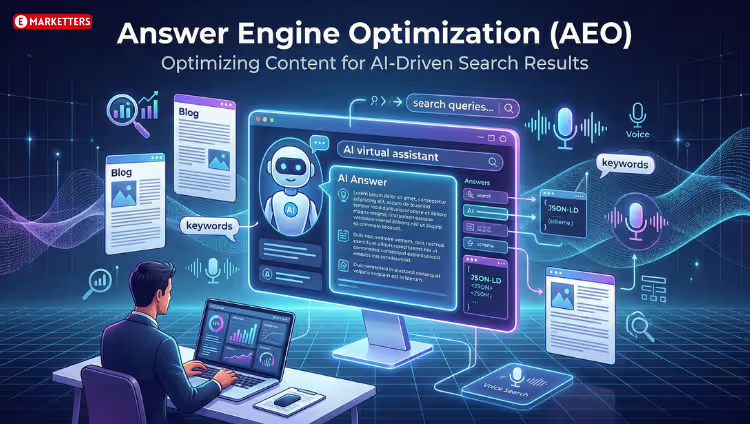
Instead of a list of websites, these AI tools give you a direct answer. This shift is called Answer Engine Optimization (AEO).
If you want your business to stay relevant, you need to make sure AI models pick your content to answer user questions. In this guide, we will break down exactly how AEO works and how you can get your content into AI responses.
What is Answer Engine Optimization (AEO)?
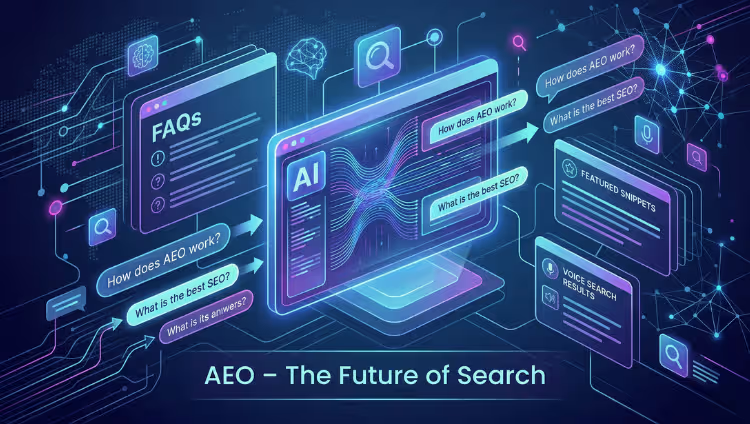
Simply put, AEO is the process of optimizing your website content so that “Answer Engines” (like ChatGPT, Perplexity, or Google’s Search Generative Experience) can find, understand, and use your information in their answers.
While traditional SEO (Search Engine Optimization) focuses on getting you to the top of search results, AEO focuses on being the source of the AI’s answer.
Why is AEO Important Right Now?
-
Zero-Click Searches: More people are getting their answers directly from the search page without clicking on any website.
-
Voice Search: People use Siri and Alexa to ask questions. These devices use answer engines.
-
Trust: If an AI mentions your brand as a top recommendation, it builds massive trust with the user.
Whether you are a local shop or the best PPC company in Lucknow, being the “chosen answer” is the new gold standard of digital marketing.
How AI Engines Pick Their Answers

To beat the system, you must understand how it works. AI models don’t just “guess.” They look for three things:
-
Authority: Is the website a trusted source?
-
Context: Does the content directly answer the user’s specific question?
-
Structure: Is the information easy for a computer to read and summarize?
If your website is messy and uses complicated language, an AI will skip it. This is why simplicity is key.
Step-by-Step Guide to Optimizing for AEO
Getting into AI responses isn’t magic. It requires a specific strategy. Follow these steps to prepare your content.
Step 1: Focus on Question-Based Keywords
AI is conversational. People don’t just type “Digital marketing Lucknow” anymore. They ask, “Which is the best Digital marketing agency in Lucknow for small businesses?”
-
How to do it: Use tools like AnswerThePublic or Google’s “People Also Ask” section. Find the exact questions your customers are asking.
-
The Goal: Create content that starts with or heavily features these questions as headings.
Step 2: Use the “Inverted Pyramid” Style of Writing
In school, we are often taught to build up to a conclusion. In AEO, you must do the opposite.
-
Direct Answer First: Put the most important information in the first two sentences.
-
Details Later: Follow up with explanations, bullet points, and data.
-
Why? AI bots are “lazy.” They want to grab the answer quickly without reading 2,000 words.
Step 3: Implement Structured Data (Schema Markup)
Think of Schema Markup as a “translator” for AI. It is a bit of code you add to your website that tells search engines exactly what your content is about.
-
FAQ Schema: Tells the AI, “Here is a question, and here is the answer.”
-
Local Business Schema: Essential if you want to be known as a top Social media marketing. It tells the AI your location, hours, and services.
-
Product Schema: Gives the AI price, availability, and reviews.
Step 4: Build E-E-A-T (Experience, Expertise, Authoritativeness, Trustworthiness)
AI engines prefer content written by experts. If you want to be seen as the best PPC company in Lucknow, you can’t just say it—you have to prove it.
-
Author Bios: Include a clear bio of the person writing the article.
-
Case Studies: Show real results you have achieved for clients.
-
Backlinks: Get other reputable websites to link to yours.
Step 5: Keep It Simple and Conversational
AI models are trained on how humans talk. Use “Class 8th to 10th level” English. Avoid heavy jargon. If a 14-year-old can understand your blog, an AI can summarize it perfectly.
Content Formats That AI Engines Love
Not all content is treated equally. If you want to appear in AI snippets, use these formats:
1. Bulleted and Numbered Lists
AI loves lists because they are easy to scan. If someone asks, “Steps to start a business in India,” and you have a clear 1-2-3 list, the AI is likely to copy that list into its response.
2. Tables for Comparison
If you are comparing services, use a table. For example, a table comparing different packages offered by a Digital marketing company in Lucknow makes it easy for AI to say, “Agency X offers more features than Agency Y.”
3. Clear Definitions
Start paragraphs with “X is…” or “Y refers to…” This helps the AI identify definitions for “What is” type questions.
The Role of Local Relevance in AEO
For businesses in specific cities, AEO is a game-changer. AI engines are very good at answering local queries.
If a user asks, “Who should I hire for Facebook ads in Uttar Pradesh?”, the AI looks for local signals. To win this:
-
Make sure your Google Business Profile is updated.
-
Mention your city and neighborhood naturally in your content.
-
Get local reviews. A SEO company in Lucknow with 50 local reviews will beat a national company with none when the user is in Lucknow.
Common Mistakes to Avoid in AEO
Even the best companies make mistakes. Here is what not to do:
-
Being Too Wordy: Don’t write 500 words of “fluff” before getting to the point.
-
Ignoring Mobile Users: Most AI interactions happen on phones. If your site is slow on mobile, AI engines might penalize your ranking.
-
Using Only Images: AI is getting better at reading images, but it still prefers text. Always use “Alt Text” for your images.
-
Not Updating Content: Information changes. If your blog about the “best marketing trends” is from 2021, the AI will ignore it for something newer.
How to Track Your AEO Success
Since AEO doesn’t always lead to a “click,” how do you know if it’s working?
-
Brand Mentions: Use tools like Google Alerts to see if people (and AI) are talking about you.
-
Search Console Insights: Look for “Impressions.” If your impressions are high but clicks are low, you might be appearing in AI answers.
-
Manual Testing: Simply ask ChatGPT or Gemini questions related to your business. Does it mention you? If not, look at who it does mention and see what they are doing differently.
As the best PPC company in Lucknow, we often track how often our strategies lead to “featured snippets” because those are the primary sources for AI responses.
The Future of Search: SEO + AEO
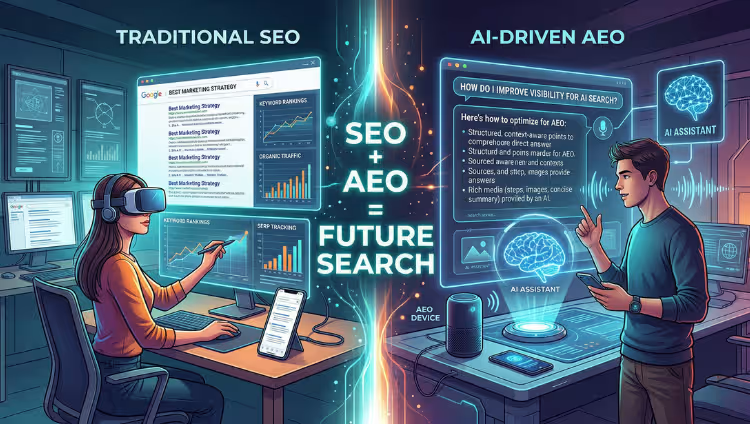
Does AEO mean SEO is dead? No.
SEO is the foundation. AEO is the house you build on top of it. You still need a fast website, good keywords, and high-quality links. However, you now need to add a “conversational layer” to your strategy.
By combining traditional search tactics with answer-focused content, you ensure that whether a person is scrolling through Google or chatting with an AI bot, they find you.
Frequently Asked Questions (FAQs)
1. What is the main difference between SEO and AEO?
SEO focuses on ranking a website in search engine results pages (SERPs) so people click on it. AEO focuses on providing the direct answer that an AI engine gives to a user, often without the user needing to click on a website.
2. Will AEO reduce my website traffic?
It might reduce “informational” traffic (people looking for quick facts), but it increases “high-intent” traffic. If an AI recommends your Digital marketing agency in Lucknow, the person clicking through to your site is much more likely to hire you.
3. How do I make my content “AI-friendly”?
Use clear headings (H1, H2, H3), write in simple sentences, use bullet points, and provide direct answers to common questions at the beginning of your articles.
4. Is Schema Markup necessary for AEO?
Yes, it is highly recommended. Schema helps AI engines understand the context of your data, such as your location, prices, and reviews, making it easier for them to cite you as a source.
5. Can a small business in Lucknow compete with big brands in AEO?
Absolutely! AI engines often prioritize local relevance and specific expertise. If you provide the best, most direct answer for a local query like “Social media marketing company in Lucknow,” the AI can favor you over a global brand that doesn’t have local focus.
6. Which AI engines should I optimize for?
Currently, you should focus on Google Gemini (which powers Google Search), ChatGPT (which uses Bing search), and Perplexity AI.
Ready to Take Your Business to the Next Level?
The digital landscape is moving toward an AI-first future. If your business isn’t optimized for Answer Engines, you are leaving money on the table. Whether you need a strategy from a top Digital marketing agency in Lucknow, data-driven results from the PPC company in Lucknow, or creative growth from a leading Social media marketing, we are here to help.
Don’t let your competitors get the last word.
[Contact Us Today for a Free AEO Audit!]
Let’s make sure AI gives YOUR name as the answer.