In 2026, the digital world has moved beyond the “10 blue links” of Google. Today, millions of users get their answers directly from ChatGPT. But have you ever wondered how ChatGPT decides which websites to mention or link to?
“Ranking” in ChatGPT isn’t about stuffing keywords into a page anymore; it’s about becoming a trusted source for the AI’s brain. If you want your brand to be the one ChatGPT recommends, you need a new playbook.
Here is how you can rank in ChatGPT and win the SEO game in 2026.
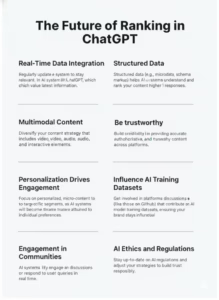
Understanding How ChatGPT Sources Information
To rank, you first need to know how the machine “reads.” In 2026, ChatGPT uses a mix of its massive training data and real-time web browsing (often powered by SearchGPT or Bing).
It doesn’t just look for words; it looks for entities (people, places, and things) and the relationships between them. When a user asks a question, ChatGPT scans the web for the most reliable, easy-to-digest answer. If your site is easy for the AI to “crawl” and “parse,” you have a seat at the table.
Create High-Quality, Authoritative Content
Content is still king, but “AI-fluff” is dead. In 2026, ChatGPT filters out generic, repetitive content. To stand out, your content must provide Information Gain—this means adding something new that isn’t already everywhere else on the internet.
-
Original Research: Share your own data, surveys, or experiments.
-
Expert Insight: Write from the perspective of someone who has actually done the work.
-
Depth: Don’t just scratch the surface. Cover a topic so well that the AI views you as the “ultimate guide.”
Optimize for Natural Language Queries
People talk to ChatGPT like a friend, not a search box. They don’t type “best pizza Lucknow”; they ask, “Where can I find the best thin-crust pizza in Lucknow that’s open after 10 PM?”
-
Conversational Tone: Write the way people speak.
-
Long-Tail Keywords: Focus on full sentences and specific questions.
-
The “Answer First” Rule: Start your paragraphs with a direct answer to a question, then provide the details.
Establish Digital Authority and Credibility (E-E-A-T)
Experience, Expertise, Authoritativeness, and Trust (E-E-A-T) are more important than ever. ChatGPT prefers to cite sources that have a “face” and a reputation.
-
Author Bios: Every article should have a clear author with real credentials and links to their social profiles.
-
Expert Quotes: Include insights from industry leaders.
-
Trust Signals: Ensure your site has an “About Us” page, clear contact info, and a secure HTTPS connection.

Leverage Structured Data and Clear Formatting
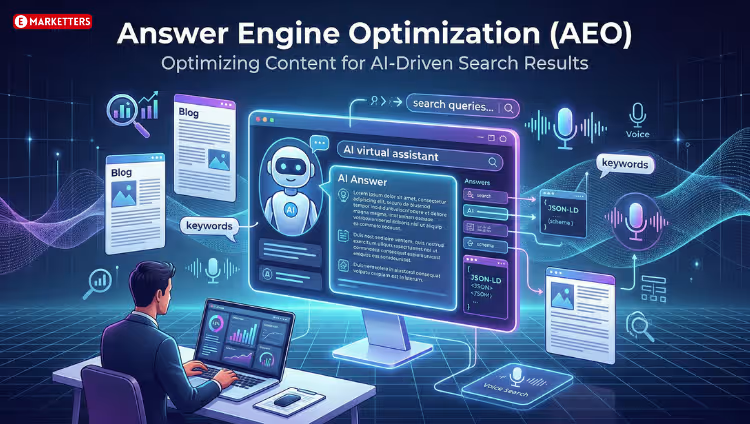
ChatGPT is a “Large Language Model,” but it loves organized data. Use Schema Markup (JSON-LD) to tell the AI exactly what your page is about.
-
FAQ Schema: Directly tells the AI your questions and answers.
-
Product Schema: Gives clear specs, prices, and reviews.
-
Organization Schema: Helps the AI understand who you are.
-
Formatting: Use H2 and H3 tags, bullet points, and tables.
Build a Strong, Consistent Online Presence
ChatGPT doesn’t just look at your website; it looks at what the rest of the web says about you.
-
Social Proof: Be active on LinkedIn, Twitter (X), and niche forums.
-
Third-Party Reviews: Positive mentions on sites like Reddit, Quora, and G2 help the AI verify that you are a legitimate authority.
-
Consistency: Keep your brand name, address, and tone the same across all platforms.
Focus on Answering Specific Questions
One of the best ways to get cited by ChatGPT is to be the best at answering “How-to” and “What-is” questions.
-
The “Snippet” Method: Create a “Key Takeaways” box at the top of your articles.
-
Problem-Solving: Identify the most common pain points in your industry and write dedicated pages that solve them.
-
Clarity: Avoid jargon. If a 10-year-old can’t understand your answer, ChatGPT might struggle to summarize it too.
Prioritize Freshness and Regular Updates
In 2026, information moves fast. ChatGPT’s “Search” feature prioritizes recent news and updated guides.
-
Content Audits: Review your top-performing blogs every 3–6 months.
-
Update Dates: Explicitly state “Last Updated: January 2026” to signal to crawlers that the info is current.
-
Live Data: If possible, use dynamic elements like live pricing or current industry stats.
Optimize Technical Elements
If the AI’s “crawler” can’t enter your site, you won’t rank.
-
Site Speed: Your site should load in under 2 seconds.
-
Mobile-First: Most AI interactions happen on mobile; your site must be flawless on a phone.
-
Clean Code: Avoid messy JavaScript that blocks the AI from reading your text.
Build Citations and References
Think of citations as “votes of confidence.”
-
Quality Over Quantity: One link from a major news site or a top industry blog is worth more than 100 low-quality links.
-
Brand Mentions: Even if a site doesn’t link to you, a simple mention of your brand name helps ChatGPT build a “knowledge graph” about you.
-
Collaborations: Guest post on reputable sites to spread your authority.
Measure and Adapt Your Strategy
SEO in 2026 is an experiment. You must track how often you are being cited.
-
Check Your Referral Traffic: Look for traffic coming from “https://www.google.com/search?q=chatgpt.com” or “openai.com.”
-
Self-Test: Ask ChatGPT questions related to your niche and see if it mentions you. If it doesn’t, see who it is mentioning and analyze their content.
-
Stay Agile: AI models update their logic frequently. Be ready to pivot your strategy as new ChatGPT versions are released.
Frequently Asked Questions (FAQs)
1. What exactly does “rank in ChatGPT” mean?
Unlike Google, where ranking means appearing in a list of 10 links, “ranking” in ChatGPT means being cited, mentioned, or recommended within the AI’s conversational response. It means your website is used as a trusted source to answer the user’s question directly.2. How often should I update my content to maintain ChatGPT visibility?
In 2026, “freshness” is a major factor. For fast-changing industries like Tech or Finance, a 30-day refresh cycle is recommended. For more stable “evergreen” topics, a quarterly (every 3 months) update ensures the AI still views your data as current and reliable.3. Can I “pay” to rank in ChatGPT?
Currently, no. ChatGPT’s organic responses are based on relevance and authority, not ad spend. However, being a well-known brand through traditional marketing can indirectly help your authority signals.4. Does word count matter for ChatGPT ranking?
Not exactly. While longer content often provides more “depth,” ChatGPT cares more about the accuracy and clarity of the answer. A 500-word expert answer will often beat a 2,000-word “fluff” article.5. Is traditional SEO dead?
No! Traditional SEO (keywords, backlinks, speed) remains the foundation. Think of AI Optimization (GEO) as “SEO 2.0.” If search engines can’t find and index your site, the AI won’t be able to read it either.Ready to Lead the AI Revolution?
Ranking in the age of AI requires a mix of technical precision and human expertise. If you want to ensure your business stays ahead of the curve in 2026, you need a partner who understands the future of search.
eMarketters is the best digital marketing agency in Lucknow, specializing in AI-driven SEO strategies that get you noticed by ChatGPT and beyond. Don’t get left behind—let’s build your digital authority today!