Google claims that AI Overviews reduce “bounce clicks”—visits where users click a link but immediately return to search because the page didn’t meet their needs. By providing answers directly, Google argues that websites lose low-quality traffic while retaining high-intent visitors, though many site owners still see this as a significant organic traffic loss.
The world of search engine optimization (SEO) is changing faster than ever. If you have been tracking your website analytics lately, you might have noticed a dip in numbers. You are not alone. As a leading SEO company in Lucknow has been analyzing these shifts closely.
Google recently introduced “AI Overviews” (formerly SGE), which provides AI-generated summaries at the top of search results. While this is great for users, website owners are worried about losing visitors. In response, Google has introduced a new term to the conversation: “Bounce Clicks.”
In this guide, we will break down what this means, why Google is saying it, and how your business can survive this new era of search.
What Are “Bounce Clicks” in Google’s Context?
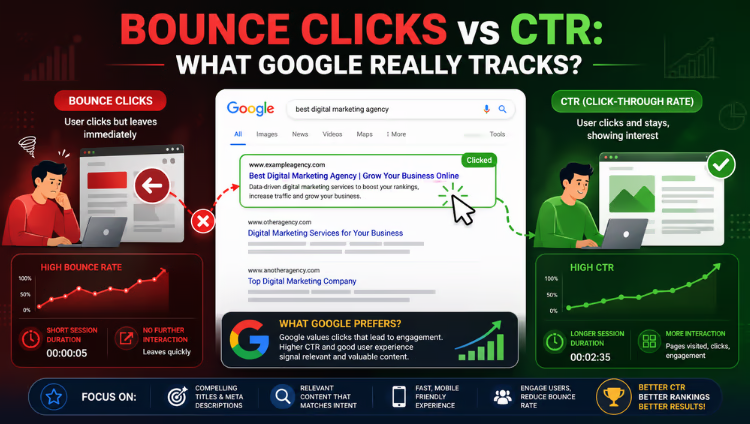
When we talk about SEO, we usually talk about “Bounce Rate.” However, Google is now focusing on “Bounce Clicks” to explain why traffic numbers are changing.
Meaning of Bounce Clicks
A “bounce click” happens when a user clicks on a search result, realizes within seconds that the page doesn’t have what they need, and clicks the “back” button to return to Google.
Bounce Rate vs. Bounce Clicks
-
Bounce Rate: This is a metric in your Google Analytics that shows the percentage of people who leave your site after viewing only one page.
-
Bounce Clicks: This is Google’s way of describing “unsatisfied visits.” Google argues that if a user finds the answer in an AI Overview, they don’t need to click a link just to “bounce” back later.
Why Google is Highlighting This
Google is essentially saying, “We aren’t stealing your good traffic; we are just stopping the bad traffic.” They claim that by answering simple questions through AI, they are saving users from clicking on links that wouldn’t have helped them anyway. However, for many digital marketers, this feels like an excuse for the overall drop in organic reach.
How AI Overview Is Changing Search Behavior
AI Overviews have fundamentally changed how people interact with the search engine results page (SERP).
What is an AI Overview
AI Overview is a feature where Google uses its AI model (Gemini) to gather information from various websites and present a summarized answer at the very top of the page.
How it Affects User Clicks
In the past, if you searched for “Benefits of green tea,” you would see a list of websites. You would click one, read, and perhaps stay. Now, the AI Overview lists the benefits directly. Many users get their answer and never feel the need to click on any website link.
Reduced Website Visits
This creates “zero-click searches.” Because the information is right there, the “click-through rate” (CTR) for organic links—even those in the top position—is starting to decline. As a premier Digital Marketing Company in Lucknow has observed that informational blogs are being hit the hardest.
Is Google Traffic Really Dropping Because of AI?
The short answer is: Yes, for certain types of content.
Industry Trends
Data from various SEO tools suggests that informational websites (those that answer “how-to” or “what is” questions) have seen a 10% to 25% drop in traffic since AI Overviews became common.
Reality vs. Perception
Google argues that the “quality” of traffic is now higher. They suggest that if someone clicks your link now, they are genuinely interested in your expertise, not just looking for a quick fact. While this sounds good in theory, it doesn’t change the fact that total visitor counts are down for many publishers.
Impact on Publishers
Publishers who rely on ad revenue (which depends on high traffic volume) are struggling. Small businesses, however, might find that their leads stay steady even if their total traffic drops, as long as they are appearing in the AI’s “cited sources.”
Is Google traffic down because of AI?
Yes, overall organic traffic for informational queries has decreased because users get answers directly on the search page without needing to click through to a website.
How Does Google AI Overview Affect Clicks?
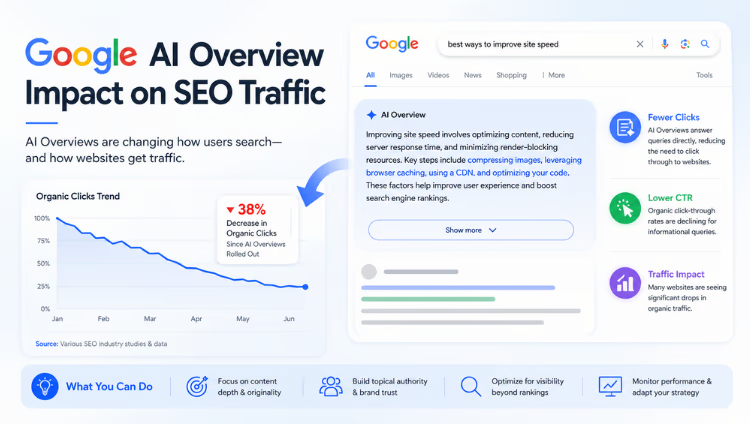
The impact on clicks can be broken down into three main areas:
-
Zero-Click Searches: Users get the answer and leave. This is the biggest threat to SEO traffic.
-
Reduced CTR for Top Results: Even if you are ranked #1, you are now physically lower on the screen because the AI box takes up so much space.
-
Content Visibility Changes: Instead of a blue link, your website might appear as a small “card” or “source” inside the AI box. If users don’t click that card, you get no traffic.
What Triggers AI Overview in Google Search?
Not every search will show an AI summary. Google tries to be smart about when to use it.
-
Informational Queries: “How does a car engine work?” or “What are the symptoms of the flu?” These almost always trigger an AI Overview.
-
Complex Comparisons: “Should I buy a laptop or a tablet for college?”
-
Multi-step Tasks: “How to plan a trip to Lucknow in 3 days.”
Google is less likely to show AI Overviews for Navigational searches (e.g., “Facebook login”) or Transactional searches (e.g., “Buy iPhone 15 Pro”).
Why Is Google Pushing AI So Aggressively?
You might wonder why Google would risk upsetting website owners. There are three main reasons:
-
The AI Race: Companies like OpenAI (ChatGPT) and Perplexity are changing how people find information. If Google doesn’t offer AI answers, users might leave Google entirely.
-
User Experience Goals: Google wants to be an “answer engine,” not just a “search engine.” They want to give users the fastest path to information.
-
Future of Search: Voice search and mobile usage require quick, summarized answers. AI is the natural evolution of this trend.
What This Means for SEO and Website Owners
The “old way” of doing SEO—just ranking for high-volume keywords—is no longer enough.
Shift from Traffic to Visibility
You need to stop focusing only on “how many people visited my site” and start looking at “is my brand being mentioned by the AI?” Being a cited source in an AI Overview builds massive brand authority.
Importance of Content Quality
If Google is filtering out “bounce clicks,” your content must be so good that when a user does click, they stay. Thin, repetitive content will no longer rank or be used by AI.
New SEO Strategies
We are moving toward AEO (Answer Engine Optimization). This means structuring your data so AI can easily read and summarize it. At eMarketters, we are already implementing these advanced strategies for our clients.
How eMarketters Helps Businesses Adapt to AI Search
As a dedicated Digital Marketing Company doesn’t just watch the trends; we get ahead of them. We understand that local businesses in India face unique challenges with these global updates.
Strategy used by eMarketters
We focus on “Entity-Based SEO.” Instead of just keywords, we help Google understand that your business is an authority in its field. We optimize your technical SEO so that your site is the first one the AI picks as a source.
Focus on Content Optimization
We don’t just write blogs; we create “Information Gains.” This means providing unique insights that an AI cannot simply scrape from other sites.
If you are looking for a reliable SEO company in Lucknow that provides the data-driven approach needed to navigate these traffic drops. We focus on engagement-driven SEO that converts visitors into customers, regardless of how Google changes its layout.
SEO Strategies to Survive AI Overview, Traffic Loss
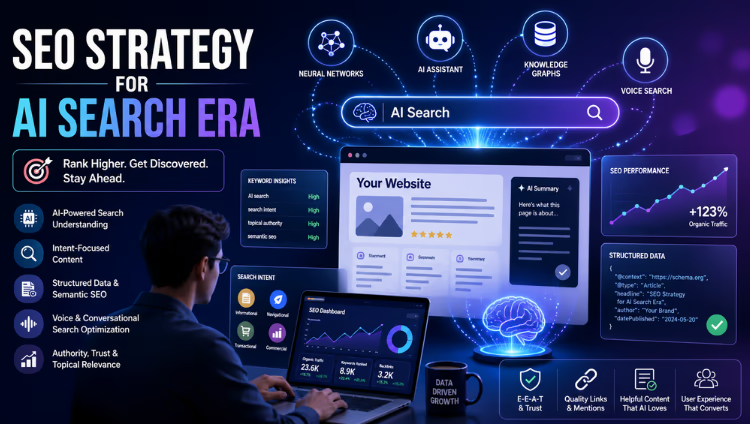
To stay ahead, you need a plan. Here are the actionable steps we recommend:
-
Optimize for Featured Snippets: AI often pulls data from the “Position Zero” snippet. Use clear headings and bullet points.
-
Focus on Brand Authority: People will still search for your specific brand. Build your reputation off-site (social media, reviews, PR).
-
Improve Engagement Signals: Make sure your pages load fast and provide immediate value to prevent those “bounce clicks” Google is talking about.
-
Use Long-Tail Keywords: AI is good at general answers, but it often misses the “niche” details. Target specific, complex questions.
-
Implement Schema Markup: Use “Speakable” and “FAQ” schema to help AI understand your content structure.
Case Study: Adapting to the AI Shift
The Problem: A local real estate client in Lucknow saw a 20% drop in organic traffic to their “Guide to Buying Property” blogs after AI Overviews rolled out.
The Strategy: eMarketters analyzed the traffic. We realized the “bounce clicks” were people looking for quick tax percentages. We updated the content to include unique neighborhood insights, local market video tours, and expert predictions—things the AI couldn’t replicate.
The Result: While total traffic didn’t return to 100% of previous levels, the conversion rate increased by 15%. The people clicking through were serious buyers, not just fact-checkers. This proves Google’s point—but only if you adapt your content strategy.
FAQs
Q.How does Google AI Overview affect clicks?
AI Overviews provide answers directly on the search page. This leads to “zero-click searches” where users get what they need without visiting a website, often lowering the click-through rate (CTR) for organic results.
Q.Is Google traffic down because of AI?
Yes, many websites have reported a drop in traffic for informational queries. However, Google claims this is mostly a loss of “bounce clicks”—users who wouldn’t have stayed on the site anyway.
Q.What triggers AI Overview in Google search?
It is mostly triggered by informational queries, “how-to” searches, and questions that require a summary of multiple sources. It is less common for local business searches or direct product purchases.
Q.Why does Google push AI so much?
Google is competing with other AI platforms like ChatGPT. To remain the world’s primary source of information, they must offer the same fast, AI-generated answers that users are starting to expect.
Q.What are bounce clicks in SEO?
Bounce clicks are visits where a user clicks a search result but immediately returns to Google. Google argues that AI Overviews satisfy these users’ needs so they don’t have to perform an “unsatisfied” click on your website.
Q.How can websites recover lost traffic?
Focus on creating high-quality, unique content that provides more depth than an AI summary. Use structured data, target long-tail keywords, and build strong brand authority so users look for your site specifically.
Conclusion: Embracing the Future with eMarketters
Google’s explanation of “bounce clicks” is a reminder that the quality of traffic matters more than the quantity. While it is frustrating to see your numbers go down, the goal of SEO remains the same: connecting the right people with the right information.
The landscape is shifting, but you don’t have to navigate it alone. Whether you are looking for a Digital Marketing Company in Lucknow to handle your overall strategy or a specialized SEO company in Lucknow to fix your traffic drops, eMarketters is here to help.
We turn AI challenges into growth opportunities. By focusing on deep authority and user engagement, we ensure your business doesn’t just survive the AI era—it thrives in it.
Losing traffic due to AI search changes?
Don’t let your business disappear from the search results. Partner with eMarketters, a trusted Digital Marketing Company in Lucknow, to adapt and grow in the AI era.
Contact us today for a free SEO audit!