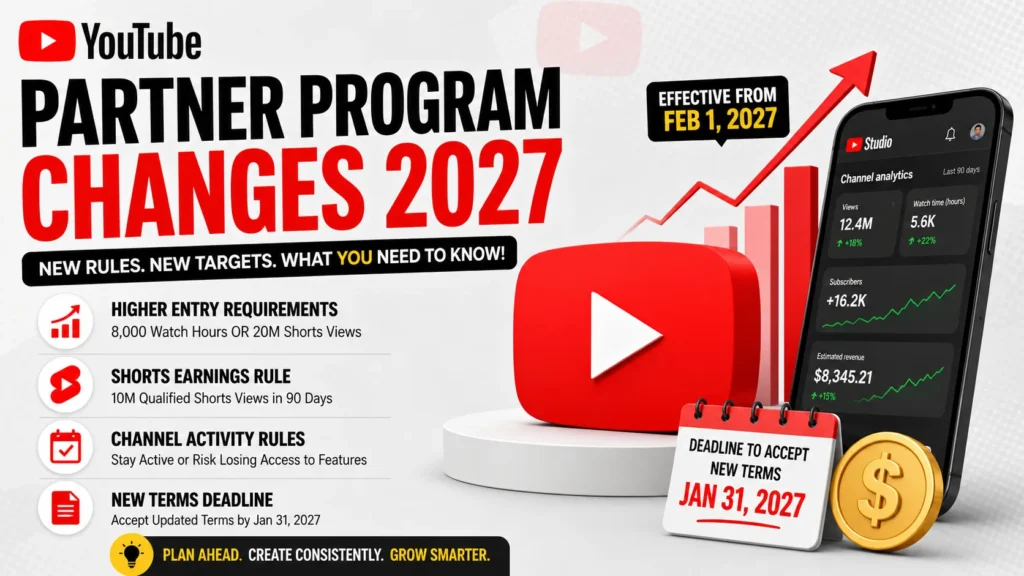
YouTube has announced major changes to its monetization ecosystem that could affect both new and existing creators from February 1, 2027. The updates include higher eligibility requirements for ad revenue, new conditions related to Shorts earnings, revised activity requirements, and updated YouTube Partner Program terms.
For creators who are working towards monetization, these changes could make the journey more challenging. For channels that are already monetized, the biggest focus will be on understanding the new rules, staying active, and accepting any updated terms within the required timeline.
In this guide, we explain the YouTube Partner Program changes 2027, what they could mean for new and existing creators, and how you can prepare your channel.
Important: At the time of writing, YouTube’s currently published Help pages still list the existing ad-revenue eligibility threshold as 1,000 subscribers plus either 4,000 valid public watch hours or 10 million valid public Shorts views. Creators should check YouTube Studio and official YouTube Help announcements for the final applicable rules before making business decisions.
What Is Changing in the YouTube Partner Program in 2027?
According to the announced 2027 changes, YouTube is expected to introduce stricter requirements for creators who want to earn advertising and YouTube Premium revenue through the YouTube Partner Program (YPP).
The main changes discussed include:
- Higher monetization thresholds for new creators
- A new minimum performance requirement for Shorts earnings
- Updated definitions of an active monetized channel
- New terms and modules for existing YPP partners
- A deadline for creators to review and accept applicable updated terms
These changes are particularly important for creators who rely heavily on YouTube Shorts for views and revenue.
YouTube Monetization Requirements: Before vs After 2027
The biggest change is expected to affect new creators applying for ad-revenue monetization.
| Requirement | Current Published Requirement | Reported From February 1, 2027 |
|---|---|---|
| Subscribers | 1,000 | 1,000 |
| Long-form watch hours | 4,000 | 8,000 qualified watch hours |
| Shorts views | 10 million in 90 days | 20 million qualified Shorts views in 90 days |
Currently, YouTube’s official Help pages state that creators can qualify for ad revenue sharing with 1,000 subscribers and either 4,000 valid public watch hours from long-form videos in the previous 12 months or 10 million valid public Shorts views in the previous 90 days.
If the reported 2027 thresholds are implemented as announced, the watch-hour and Shorts-view requirements for new creators would effectively double.
What Do the New Requirements Mean for New YouTubers?
For new creators, the path to full ad-revenue monetization may become more competitive.
Instead of focusing only on reaching 1,000 subscribers, creators may need to build a stronger content strategy that generates consistent watch time or large-scale Shorts reach.
For example, a creator who currently reaches:
- 1,000 subscribers
- 5,000 watch hours
would meet the current published watch-hour requirement. However, under the reported 2027 threshold, that same channel may still need additional qualified watch hours before becoming eligible for full ad revenue sharing.
The same applies to Shorts creators. Reaching millions of views is already challenging, and a potential increase from 10 million to 20 million views within a rolling 90-day period would raise the entry barrier significantly.
What Is the New 10 Million Shorts Views Rule?
One of the most important reported changes involves creators who are already monetized and earn through the Shorts Creator Pool.
Under the new system described in the announcement, a channel may need to receive 10 million qualified Shorts views during the previous 90 days to earn from the Shorts Creator Pool for that month.
This is different from simply staying in the YouTube Partner Program.
A creator may remain part of YPP while becoming temporarily ineligible for Shorts revenue sharing if the required Shorts performance threshold is not met.
Example
Suppose a monetized channel receives:
- 2 million Shorts views in the previous 90 days
- Strong views on long-form videos
Under the reported rule, the channel could continue earning from eligible long-form content while not receiving Shorts Creator Pool earnings for that period.
Once the channel again reaches the required qualified Shorts-view threshold, Shorts revenue sharing could resume.
This could have a major impact on creators whose primary income comes from viral Shorts content.
Will Existing Monetized Channels Lose Their YPP Status?
The reported changes indicate that existing YouTube Partner Program members would not automatically lose their YPP status simply because they do not meet the higher entry requirements being introduced for new creators.
This distinction is important.
The higher entry threshold is primarily about joining the ad-revenue level of YPP, while existing partners may be subject to separate activity and monetization requirements.
Creators should not confuse these two situations:
- Eligibility requirements for new creators joining the program
- Requirements for existing creators to remain active and continue accessing specific monetization features
YouTube’s current official documentation also makes clear that monetization eligibility involves multiple requirements and that channels are continuously reviewed for compliance with monetization policies.
New YouTube Channel Activity Rules Explained
Another important part of the reported 2027 update concerns channel activity.
Previously, YouTube’s inactivity guidance focused on channels that had not uploaded videos or used the Posts feature for an extended period.
Under the reported new rules, a channel may need to meet at least one activity condition, such as:
- 1,000 qualified watch hours during the previous 12 months
- 1 million qualified Shorts views during the previous 90 days
- At least 2 long-form uploads during 90 days
- At least 5 Shorts uploads during 90 days
The goal appears to be ensuring that monetized channels remain genuinely active.
Why This Matters
Many creators take long breaks after monetization. Some channels may also generate occasional views from old videos without regularly publishing new content.
If the reported activity requirements are applied, creators may need to maintain a more consistent publishing schedule.
The good news is that creators may have multiple ways to demonstrate activity. A channel does not necessarily need millions of views if it continues publishing content regularly.
What Happens If Your Channel Becomes Inactive?
According to the reported changes, a channel that does not meet the activity criteria may receive an additional opportunity to become active again.
This means inactivity may not necessarily result in immediate removal from the YouTube Partner Program.
However, creators should not wait until they receive a warning.
A simple and consistent publishing strategy can help reduce this risk. For example:
- Publish at least one long-form video every month
- Post Shorts consistently
- Monitor watch hours and Shorts views in YouTube Studio
- Keep track of your monetization status through the Earn tab
Consistency will become increasingly important as YouTube continues to focus on active, original, and policy-compliant channels.
Existing YouTube Partners May Need to Accept New Terms
Creators who are already part of the YouTube Partner Program should also pay attention to updated terms and monetization modules.
The reported deadline is January 31, 2027, with the changes taking effect from February 1, 2027.
The relevant terms may include:
- Watch Page Monetization Module
- Shorts Monetization Module
- Commerce Product Module, where applicable
Creators who do not accept required terms could lose access to certain monetization features until the updated terms are accepted.
YouTube has previously used a modular monetization structure, where different modules are required for different earning opportunities. For example, the Watch Page Monetization Module covers monetization for long-form and live content, while the Shorts Monetization Module applies to revenue sharing from eligible Shorts Feed ads.
What Should Creators Do Before February 1, 2027?
Whether you are already monetized or working towards monetization, it is a good idea to prepare early.
1. Check Your YouTube Studio Earn Tab
The first place to check for monetization updates is YouTube Studio.
Keep an eye on:
- Monetization eligibility
- New terms and agreements
- Notifications from YouTube
- Required actions
Do not rely only on third-party news reports or social media posts.
2. Build Both Shorts and Long-Form Content
Relying entirely on one content format can be risky.
A strong strategy for 2027 could include:
- Shorts for reach and audience discovery
- Long-form videos for watch time
- Community posts for audience engagement
- Live streams where relevant to your niche
Long-form and Shorts can support each other when used strategically.
For example, a creator can publish a Short to introduce a topic and direct interested viewers to a detailed long-form video.
3. Focus on Quality, Not Just Views
If monetization requirements become stricter, simply uploading a large number of low-quality videos may not be an effective strategy.
Creators should focus on:
- Original content
- Strong hooks
- Better audience retention
- Clear thumbnails and titles
- Relevant topics
- Consistent publishing
- Following YouTube monetization policies
Meeting a view threshold does not automatically guarantee acceptance into YPP. YouTube reviews channels to determine whether they meet applicable monetization policies.
4. Track Your 90-Day Shorts Performance
Shorts creators should pay close attention to the rolling 90-day period.
A rolling period means that older views eventually move outside the calculation window.
For example, if a Short received 2 million views four months ago, those views may no longer help you meet a 90-day threshold.
This makes consistency more important than relying on one viral video.
A sustainable Shorts strategy could include:
- Publishing consistently
- Testing different topics and formats
- Improving the first few seconds
- Studying audience retention
- Creating content around proven topics
5. Do Not Ignore YouTube Notifications
One of the easiest mistakes a creator can make is ignoring YouTube Studio notifications.
If YouTube introduces new terms or requires action, missing the deadline could affect access to monetization features.
Make it a habit to regularly check:
- YouTube Studio Dashboard
- Earn tab
- Channel notifications
- Registered email account
This is especially important for businesses and agencies managing multiple YouTube channels.
Should You Focus on Shorts or Long-Form Videos in 2027?
The answer depends on your niche, audience, and goals.
However, based on the reported changes, a combined strategy may be safer than depending completely on Shorts.
Benefits of Shorts
Shorts can help you:
- Reach new audiences quickly
- Gain subscribers
- Test content ideas
- Increase brand awareness
- Drive viewers towards long-form videos
Benefits of Long-Form Videos
Long-form content can help you:
- Build watch hours
- Establish authority
- Improve audience loyalty
- Create multiple monetization opportunities
- Generate deeper engagement
YouTube’s current monetization structure also treats long-form watch hours and Shorts views as separate eligibility routes. Importantly, watch time from Shorts in the Shorts Feed does not count toward the long-form public watch-hour requirement.
Therefore, creators should clearly understand which metric their content is helping them build.
How These Changes Could Affect Digital Marketers and Businesses
The YouTube Partner Program changes are not important only for individual creators.
Businesses, brands, and digital marketing agencies that manage YouTube channels should also review their content strategies.
A business that only publishes occasional promotional Shorts may find it difficult to maintain consistent growth.
Instead, businesses can create a balanced content strategy involving:
- Educational videos
- Industry tips
- Product demonstrations
- Customer stories
- Short-form clips
- Tutorials
- Expert interviews
- Frequently asked questions
The objective should not be only to achieve monetization. YouTube can also support brand awareness, lead generation, website traffic, and long-term authority.
Frequently Asked Questions About YouTube Monetization Changes 2027
1. When will the new youtube-partner-program-changes-2027 take effect?
The reported changes are scheduled to take effect on February 1, 2027. However, creators should verify the final requirements through official YouTube Help pages and YouTube Studio before taking action.
2. Will existing YouTube Partners need 8,000 watch hours?
Based on the reported announcement, existing YPP members are expected to retain their program status rather than being required to requalify under the new entry threshold. However, they may still need to comply with updated activity and monetization rules.
3. Will YouTube Shorts require 10 million views to earn money?
The reported update states that a monetized channel may need 10 million qualified Shorts views within a rolling 90-day period to receive Shorts Creator Pool earnings for a particular period.
4. Will I lose long-form video earnings if I do not reach the Shorts threshold?
Based on the reported rules, failing to meet the Shorts performance threshold would affect Shorts Creator Pool earnings rather than automatically stopping eligible long-form ad revenue.
5. What are the current official YouTube monetization requirements?
At the time of writing, YouTube’s published Help pages list 1,000 subscribers plus either 4,000 valid public watch hours in the previous 12 months or 10 million valid public Shorts views in the previous 90 days for ad revenue sharing.
6. Should I stop creating Shorts?
No. Shorts can still be a powerful tool for reach and audience growth. However, depending entirely on Shorts may be risky if future monetization requirements include higher performance thresholds.
Final Thoughts
The YouTube Partner Program changes 2027 could represent one of the biggest shifts in YouTube monetization for creators in recent years.
For new creators, the reported increase to 8,000 qualified watch hours or 20 million qualified Shorts views would raise the difficulty of qualifying for ad revenue. For existing creators, the more immediate concerns are likely to be Shorts earning requirements, channel activity, and accepting updated monetization terms on time.
The best strategy is not to chase only one metric.
Creators should focus on building a sustainable YouTube channel with high-quality content, a consistent publishing schedule, strong audience engagement, and a combination of Shorts and long-form videos.
Most importantly, always verify major monetization changes directly through YouTube Studio and official YouTube Help documentation before changing your business or content strategy. As of the latest published official Help pages reviewed for this article, YouTube still displays the existing 1,000-subscriber, 4,000-watch-hour or 10-million-Shorts-view ad-revenue eligibility requirements.
Need Help Growing Your YouTube Channel?
At eMarketters, we help businesses and creators build effective digital strategies through SEO, content marketing, social media, video marketing, and performance-focused campaigns.
If you want to improve your YouTube content strategy and turn video content into a stronger digital marketing channel, a planned approach focused on audience growth, content quality, search visibility, and long-term brand building can make a significant difference.
Contact eMarketters to build a smarter digital growth strategy for your brand.