The landscape of digital discovery is undergoing its most significant transformation since the invention of the search engine itself. We are moving away from a world of “ten blue links” and into an era of “answers.” For businesses, this means that showing up on page one of Google is no longer the sole metric of success. Today, you need to be the primary source cited by ChatGPT, the top recommendation in Perplexity, and the featured insight in Google’s AI Overviews.
A technical SEO audit for AI search visibility helps ensure ChatGPT, Perplexity, and AI crawlers can access, understand, and cite your content through proper crawlability, sitemap optimization, robots.txt management, and rendering accessibility.
What’s Actually Happening On Your Site: The New Era of Crawling
In the past, you really only had to worry about Googlebot and perhaps Bingbot. Today, your server logs likely show a swarm of new visitors. These aren’t humans, and they aren’t traditional search bots. These are AI crawlers, and they interact with your site in three distinct ways.
The Three Bots Visiting Your Site & Their Impact On SERP Visibility
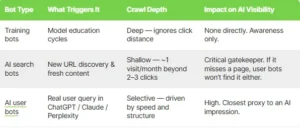
To run an effective audit, you must first understand who is knocking at your digital door. Not all AI bots are created equal.
1. Training Bots (The Data Hounds)
These bots are the “librarians” of the AI world. They crawl the web to build the massive datasets used to train models like GPT-4, Claude 3, and Gemini.
-
Key Actors: OpenAI’s GPTBot, Anthropic’s Claude-Bot, and CCBot (Common Crawl).
-
Impact: These bots don’t necessarily lead to immediate traffic. Instead, they “absorb” your brand’s knowledge. If these bots are blocked, your brand may simply not exist in the “latent space” of an LLM. When a user asks an AI about your industry, the AI won’t know you exist if its training bot was blocked.
2. AI Search Bots (The Real-Time Explorers)
These bots are part of “Search-Augmented” systems. When you ask Perplexity a question, it doesn’t just rely on its memory; it sends a bot to browse the live web.
-
Key Actors: PerplexityBot, OAI-SearchBot (SearchGPT), and Google’s Googlebot (specifically for AI Overviews).
-
Impact: These are high-value bots. They provide the citations and links that drive direct “referral” traffic from AI interfaces back to your website.
3. AI User Bots (The On-Demand Agents)
When a user pastes a URL into ChatGPT and says “summarize this,” a specific “User Bot” is triggered.
-
Key Actors: ChatGPT-User.
-
Impact: These bots act on behalf of a specific person. Blocking them can lead to a poor user experience, as the AI will tell the user, “I’m sorry, I cannot access that website.”
Which SEO Signals Do LLMs Respect?
During your audit, you need to know which levers actually move the needle. Unlike traditional SEO, where we obsess over thousands of factors, AI bots prioritize accessibility and authority.
-
Sitemaps: These remain the “GPS” for AI bots. They are broadly supported and help AI search bots find your most recent updates for real-time retrieval.
-
Robots.txt: This is your primary control center. Most major AI players (OpenAI, Anthropic, Google) have committed to respecting robots.txt directives. This is where you decide if you want to be “trained on” or “cited by.”
Signals Best Saved For Traditional SEO
Interestingly, some traditional signals have less impact on AI:
-
Canonical Tags & Noindex: While critical for Google, most AI training bots ignore these. If a page is public, a training bot will likely ingest it regardless of a “noindex” tag, unless the bot is specifically blocked in robots.txt.
-
LLM.txt: You might have heard of a new proposal for an LLM.txt file (a markdown file intended for AI). Currently, this does very little. It is not a standardized web protocol yet. Focus on your robots.txt and sitemap first.
-
JavaScript Rendering: This is the biggest “blind spot.” Many AI crawlers are “lite.” They don’t always want to spend the computing power to render complex JavaScript. If your content is hidden behind a heavy JS framework, the AI might see a blank page.
How To Make Sure ChatGPT, Perplexity & LLMs Can Reach Your Content
For a Digital Marketing Company in Lucknow looking to scale global brands, the goal is “Technical Accessibility.” If an AI can’t read it, it can’t recommend it.
-
Prioritize Crawlable HTML: Move as much content as possible into the raw HTML. If an AI bot has to wait for a script to fire to see your product descriptions, you are at a disadvantage.
-
Server-Side Rendering (SSR): If you use frameworks like React or Vue, use SSR. This ensures the bot receives a fully formed page immediately upon request.
-
Clean Site Architecture: AI bots prefer a “flat” hierarchy. If your best content is buried five clicks deep, a real-time search bot (like Perplexity) might timeout before it finds the relevant information.
-
Internal Linking: Use descriptive anchor text. AI bots use internal links to understand the “semantic relationship” between your pages.
-
Fast-Loading Pages: Speed is a ranking factor for Google, but for AI bots, it’s an “access factor.” AI agents often have strict timeout limits when fetching data for a user.
The Technical Audit: A Step-by-Step Checklist
Now, let’s get into the “meat” of the audit. As we do at eMarketters, we treat this as a forensic investigation of your site’s AI readiness.
1. The Robots.txt Audit
Open your yourwebsite.com/robots.txt.
-
Check for GPTBot: Do you allow it? If you block it, you are opting out of the world’s most popular AI.
-
Check for OAI-SearchBot: This is for SearchGPT. You should almost always allow this if you want traffic.
-
The “All Bot” logic: Many sites use User-agent: * Disallow: /. This is a death sentence for AI visibility. Ensure you are specifically allowing reputable AI agents.
2. The Sitemap Audit
AI search is about recency.
-
Check <lastmod> tags: Are they accurate? AI search bots use these to decide if they need to re-crawl your page for the latest answer.
-
Sitemap Size: Keep sitemaps under 50,000 URLs. Break them into smaller, topical sitemaps (e.g., blog-sitemap.xml, product-sitemap.xml) to help AI bots prioritize.
3. The Rendering Audit (The JS Test)
Use a tool like “View Rendered Source” or Google Search Console’s “URL Inspection Tool.”
-
The “Text-Only” Test: Disable JavaScript in your browser. Can you still read the core content? If not, the AI likely can’t either.
-
Content Hydration: Ensure that your “Title,” “Author,” and “Main Body” are not dynamically injected too late in the loading process.
4. The AI Accessibility Audit
This is a new type of audit.
-
Header Structure: Use H1-H4 tags logically. AI models use these to create “embeddings” (mathematical representations of your content). Messy headers lead to messy AI understanding.
-
Data Density: Is your content “fluff-free”? AI bots are looking for facts. Ensure your technical specs, prices, and “how-to” steps are in clear, readable text.
JavaScript SEO Problems That Hurt AI Visibility
JavaScript is the double-edged sword of modern web development. While it creates beautiful experiences for humans, it often creates “walls” for AI.
Hydration Issues
In many modern apps, the server sends a basic “shell,” and the JavaScript “hydrates” it with content later. If an AI crawler (which is often optimized for speed) leaves the page before hydration is complete, it sees an empty shell. This is a common reason why brands wonder why they aren’t being cited in AI Overviews despite having great content.
Hidden Content (Tabs and Accordions)
If your content is hidden inside a “Click to Expand” accordion that requires a JavaScript “click” event to load the text into the DOM, most AI bots will miss it. For AI visibility, hidden content is non-existent content.
Blocked Scripts
If your robots.txt blocks the /scripts/ folder, the bot can’t fetch the code needed to render the page. This leads to a broken layout and “hallucinations” where the AI guesses what is on your page because it can’t actually see it.
Structured Data & Entity Signals for AI Search
If technical SEO is the “pipes,” then Structured Data (Schema Markup) is the “labeling” on the pipes. For Generative Engine Optimization (GEO), Schema is your most powerful tool.
From Keywords to Entities
Traditional SEO focused on the keyword “Best SEO Company.” AI focuses on the Entity. An entity is a concept that the AI understands—like a specific company, a person, or a place.
Essential Schema for AI
-
Organization Schema: Tell the AI exactly who you are, your logo, and your social profiles. This builds “Entity Trust.”
-
Product & Offer Schema: Crucial for AI Shopping agents.
-
Author Schema: AI models prioritize “E-E-A-T” (Experience, Expertise, Authoritativeness, and Trustworthiness). Linking an article to a verified author entity helps the AI trust the information.
-
FAQ Schema: This is “gold” for AI search. AI bots love structured Question/Answer pairs because they can directly lift them into an AI response.
The New KPI: Technical Accessibility
In a world where search is becoming conversational, our KPIs must change. At eMarketters, our Digital Marketing Company in Lucknow is moving away from just tracking “Rankings.” We now look at:
-
Crawl Accessibility: What percentage of our high-value pages were successfully fetched by OAI-SearchBot this month?
-
Citation Frequency: How often is our brand name linked as a source in Perplexity or ChatGPT?
-
Entity Trust Score: Does the AI recognize our brand as an authority in its niche?
-
Answer Retrieval Rate: When a user asks a question related to our primary keywords, does the AI include our data in the answer?
The future of SEO is about Discoverability + Accessibility + Authority.
Common Technical SEO Mistakes Blocking AI Visibility
During our audits, we see the same mistakes repeated across industries. Avoid these to stay ahead:
-
Over-reliance on “Client-Side” Frameworks: If your site is 100% Client-Side Rendered (CSR), you are essentially invisible to many smaller AI crawlers.
-
Fragmented Internal Linking: If your site has “orphan pages” (pages with no internal links), an AI bot will never find them. Unlike Google, which might find them via external links, AI search bots rely heavily on the site’s own structure.
-
Using Images for Text: If your pricing or key features are inside an image, an AI crawler (without expensive OCR enabled) will skip right over them. Use text. Always.
-
Slow Time to First Byte (TTFB): If your server takes 2 seconds to respond, an AI agent fetching a “live” answer for a user will likely give up and move to your competitor’s site.
Future of Technical SEO in the AI Search Era
We are entering the age of Generative Engine Optimization (GEO). Technical SEO is no longer a “set it and forget it” task. It is a continuous process of ensuring your website acts as a high-quality data source for the world’s most powerful minds—AIs.
AI-first indexing is already here. Google is already using LLMs to understand the intent of your code, not just the keywords. In the future, we may see “negotiation” between bots and websites via specialized protocols. Until then, your best bet is a clean, fast, and highly structured technical foundation.
Final Thoughts
AI search visibility depends heavily on accessibility. If you want to be part of the conversation that ChatGPT and Perplexity are having with their users, you must remove every technical barrier standing in their way.
Crawlability matters more than ever. In the traditional search era, a crawl error meant a missing link. In the AI era, a crawl error means a missing identity. As technical SEO evolves, the focus shifts from “helping bots find us” to “helping models understand us.”
Future SEO equals discoverability plus accessibility plus authority. Brands working with eMarketters can build AI-ready SEO strategies focused on technical accessibility, GEO optimization, and future AI search visibility. We ensure that your business isn’t just a result on a page, but a trusted answer in a conversation.
FAQs
Q.What is AI search visibility?
AI search visibility is the measure of how easily AI-powered engines (like ChatGPT, Perplexity, and Gemini) can find, process, and cite your website’s content in their answers.
Q.Do ChatGPT and Perplexity crawl websites?
Yes. While ChatGPT was originally trained on static datasets, it now uses “SearchGPT” and user-triggered bots to browse the live web. Perplexity is a “search-first” AI that crawls the web in real-time to provide cited answers.
Q.Does robots.txt affect AI crawlers?
Absolutely. Most major AI companies have agreed to honor robots.txt directives. You can use specific user-agents like GPTBot or PerplexityBot to allow or block these engines from your site.
Q.Can JavaScript hurt AI SEO visibility?
Yes. Many AI crawlers are optimized for speed and may not fully execute complex JavaScript. If your content is only visible after a script runs, the AI might miss it entirely. Using Server-Side Rendering (SSR) is the best fix.
Q.What is the difference between traditional SEO and GEO SEO?
Traditional SEO focuses on ranking in the “ten blue links” of search engines like Google. GEO (Generative Engine Optimization) focuses on being cited as a source within AI-generated responses and conversational interfaces.
👉 AI search engines are changing how websites get discovered online. Technical accessibility, crawlability, and AI-ready site architecture are becoming essential for visibility inside ChatGPT, Perplexity, Gemini, and future answer engines.
Partner with eMarketters, the premier Digital Marketing Company in Lucknow, to build AI-ready SEO strategies, improve technical accessibility, and strengthen your brand’s AI search visibility. Contact us today to future-proof your digital presence.