To design an SEO-friendly website from scratch, you must integrate technical optimization, responsive mobile design, fast loading speeds, and a logical site architecture from the initial planning phase. Success requires high-quality, intent-driven content supported by schema markup and a focus on user experience to ensure maximum visibility across traditional search engines and modern AI discovery platforms.
Introduction: Why Does Website Design Matter for SEO in 2026?
In the current digital landscape, the line between website design and search engine optimization has completely vanished. As we move through 2025 and into 2026, Google’s algorithms, along with AI-driven search engines like ChatGPT and Perplexity, no longer just look at keywords. They look at how a user interacts with your digital home. An SEO-friendly website is no longer a luxury; it is the fundamental infrastructure upon which your entire digital marketing strategy rests.
When you begin the journey of building a site, you aren’t just creating a visual brochure. You are building a high-performance engine. If the engine is built poorly, no amount of high-octane fuel (content) will make it win the race. At eMarketters, we consistently see that businesses that prioritize SEO during the design phase achieve 3x faster indexing and significantly higher conversion rates compared to those who “add SEO later.”
For businesses seeking a professional edge, partnering with a Website Development Company in Lucknow ensures that the technical foundation is laid correctly from day one. In an era where AI Overviews (SGE) and Generative Engine Optimization (GEO) dominate, your design must be as readable to a machine as it is beautiful to a human.
Can a Beautiful Website Still Fail to Rank?
The short answer is yes. A website can be visually stunning, featuring high-resolution videos and complex animations, yet remain invisible to Google. This happens when design takes precedence over functionality. Heavy scripts can slow down a page, hidden text in Flash or complex JavaScript can go unindexed, and a lack of mobile responsiveness can lead to a “Mobile-First Indexing” penalty.
SEO-friendly design ensures that beauty and brains coexist. It’s about creating a balance where the aesthetic attracts the user, but the underlying code satisfies the search engine bot.
Why SEO Should Start Before Development Begins
The most expensive mistake a business can make is treating SEO as a “plugin” or a final polish. SEO is the blueprint. It dictates the URL structure, the hierarchy of pages, and the choice of technology stack. By integrating SEO at the wireframing stage, you avoid the need for costly site migrations or structural overhauls six months down the line. When eMarketters consult on new builds, we emphasize that the design must serve the search intent of the target audience.
Why Is Website Planning the First Step Toward SEO Success?
Planning is where the “SEO” in SEO-friendly website truly begins. Without a map, you are likely to build a labyrinth that both users and bots will abandon. Planning involves aligning your business objectives with the way people actually search for your services.
How Do You Define Website Goals Before Development?
Before a single line of code is written, you must ask: What is the primary purpose of this site? Is it lead generation, e-commerce sales, or brand authority? Each goal requires a different design philosophy. A lead-gen site needs prominent Call-to-Actions (CTAs) and fast-loading landing pages, while an e-commerce site requires a deep, categorized architecture that handles thousands of product SKUs without losing “link equity.”
How Do You Identify Your Target Audience?
Understanding your audience goes beyond demographics; it’s about understanding their “search journey.” Are they in the awareness stage (searching for “how-to” guides) or the decision stage (searching for a specific brand)? Designing for the audience means creating a layout that answers their questions immediately. This approach satisfies Google’s Helpful Content Guidelines by putting the user’s needs at the center of the design.
Why Does Competitor Research Matter?
Competitor research isn’t about copying; it’s about identifying “content gaps” and “feature gaps.” By analyzing the top-ranking sites in your niche, a Website Development Services in Lucknow can identify which keywords they rank for and what type of user experience they offer. If all your competitors have a “Price Calculator” and you don’t, you are already at a disadvantage.
How Should You Structure Your Website for Better SEO?
Website structure, or “Siloing,” is the process of organizing your website’s content into distinct categories. This helps search engines understand the context of your pages and establishes you as an authority in specific topics.
What Is the Ideal Website Hierarchy?
The ideal hierarchy is a pyramid. The Homepage sits at the top, followed by main category pages, and finally, sub-category or individual blog pages. This flow ensures that “link juice” (authority) passes from the homepage down to the deepest parts of the site.
Sample Website Architecture:
-
Level 1: Homepage (The Authority Hub)
-
Level 2: Service Categories (e.g., Digital Marketing, Web Development)
-
Level 3: Specific Services (e.g., SEO Services, UI/UX Design)
-
Level 4: Supporting Content (e.g., Blog posts, Case studies, FAQs)
How Many Clicks Should Important Pages Be From the Homepage?
A golden rule in SEO-friendly website design is the “Three-Click Rule.” No important piece of information should be more than three clicks away from the homepage. Deeply buried pages are rarely crawled by bots and are rarely visited by users.
Why Does Internal Linking Improve Rankings?
Internal links are the threads that sew your website together. They tell Google which pages are most important. By using descriptive anchor text, you provide context to the search engine. For example, instead of “Click Here,” use “Our Web Development Services.” This tells the bot exactly what the destination page is about.
Which CMS Is Best for Building an SEO-Friendly Website?
The Content Management System (CMS) you choose acts as the foundation of your site. Some systems make SEO easy, while others create technical hurdles that require constant workarounds.
Is WordPress Still the Best Choice?
For the vast majority of businesses, WordPress remains the king of SEO. This is due to its extensive ecosystem of SEO-focused plugins (such as Rank Math and Yoast), its clean code structure, and the ease with which you can implement schema markup. eMarketters often recommend WordPress for its flexibility and “future-proof” nature.
When Should You Choose Shopify, Webflow, or Custom Development?
-
Shopify: Best for e-commerce. It has excellent out-of-the-box SEO for products but can be restrictive for blog layouts.
-
Webflow: Excellent for designers who want clean, semantic code without the bloat of many WordPress plugins.
-
Custom Development: Necessary for complex web applications. However, this requires a highly skilled team to build in SEO manually features that a CMS would provide automatically.
What Features Should Every CMS Include?
An SEO-ready CMS must allow for:
-
Editable Meta Titles and Descriptions.
-
Automatic generation of XML Sitemaps.
-
Customizable URL slugs.
-
Canonical tag support.
-
Easy integration of Header tags (H1-H6).
How Important Is Mobile-First Website Design?
Since 2019, Google has primarily used the mobile version of a site’s content for indexing and ranking. If your website looks great on a desktop but is broken on a smartphone, you will not rank.
Why Does Google Prioritize Mobile Experience?
The majority of global search traffic now comes from mobile devices. Google’s goal is to satisfy its users; therefore, it prioritizes sites that offer a seamless mobile experience. This includes touch-friendly navigation, readable font sizes, and no intrusive interstitials (pop-ups).
How Can You Make Your Website Fully Responsive?
Responsive design means the website layout “responds” or adjusts based on the screen size it is being viewed on.
-
Use a Fluid Grid: Use percentages for widths instead of fixed pixels.
-
Optimize Images: Ensure images don’t overflow their containers.
-
Media Queries: Use CSS to change the layout for specific breakpoints (Mobile, Tablet, Desktop).
What Mobile Design Mistakes Should You Avoid?
-
Small Touch Targets: Buttons that are too close together are frustrating for mobile users.
-
Heavy Unoptimized Images: These kill mobile loading speeds.
-
Hidden Content: Do not hide content on mobile that is present on desktop; Google may ignore it.
Why Does Website Speed Matter for SEO?
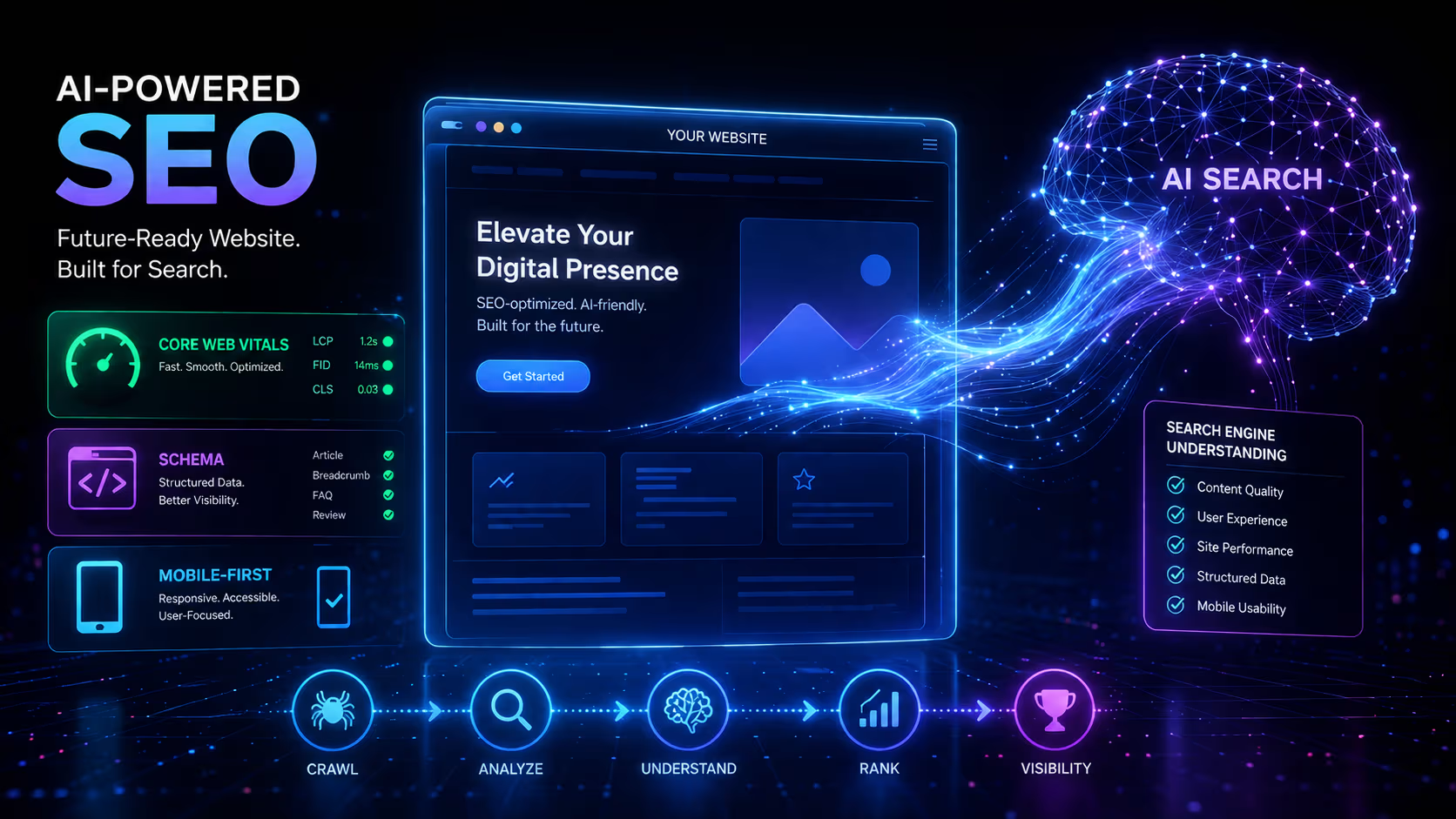
Speed is a confirmed ranking factor. In 2021, Google introduced Core Web Vitals, a set of metrics that measure the real-world user experience for loading performance, interactivity, and visual stability.
What Slows Down a Website?
The most common culprits are:
-
Unoptimized, high-resolution images.
-
Excessive use of JavaScript and third-party scripts.
-
Poor server response times (cheap hosting).
-
Lack of a Content Delivery Network (CDN).
How Can You Improve Core Web Vitals?
To pass the Core Web Vitals assessment, focus on:
-
LCP (Largest Contentful Paint): Ensure the main content loads in under 2.5 seconds.
-
FID (First Input Delay): Ensure the site is interactive in under 100ms.
-
CLS (Cumulative Layout Shift): Avoid elements jumping around while the page loads.
Which Speed Optimization Techniques Deliver the Biggest Results?
Implementing “Lazy Loading” (loading images only as the user scrolls) and “Minification” (removing unnecessary characters from code) are essential. Additionally, moving to a managed hosting provider can instantly shave seconds off your load time.
What Technical SEO Elements Should Every Website Include?
Technical SEO is the process of ensuring that a website meets the technical requirements of modern search engines. Without this, even the best content can go unread.
Why Are Clean URLs Important?
A clean URL like example.com/web-design-services is much better than example.com/p=123&cat=9. Clean URLs tell the user and the bot exactly what is on the page.
How Should XML Sitemaps Be Configured?
An XML sitemap is a roadmap of your website that you submit to Google Search Console. It should only include your “money pages”—those you want to rank—and exclude “noindex” pages like login screens or thank-you pages.
Why Is Robots.txt Important?
The robots.txt file tells search engine spiders which pages or sections of your site should not be crawled. This helps manage your “crawl budget,” ensuring Google focuses on your most important pages.
What Is Canonicalization?
Canonical tags (rel=”canonical”) are used when you have multiple versions of the same page. They tell Google which version is the “master” copy, preventing duplicate content issues that can dilute your ranking power.
Why Is HTTPS Mandatory?
Security is a top priority for Google. An SSL certificate (HTTPS) is a mandatory ranking signal. Sites without it are flagged as “Not Secure” by browsers, leading to a massive spike in bounce rates.
How Should You Design SEO-Friendly URLs?
URL design is a small but mighty part of an SEO-friendly website.
What Makes a URL Search-Friendly?
A search-friendly URL is short, descriptive, and keyword-rich.
-
Bad: emarketters.com/blog/2024/05/01/post-id-7762
-
Good: emarketters.com/seo-friendly-website-design
Which URL Mistakes Hurt Rankings?
Avoid using underscores (_); use hyphens (–) instead, as search engines treat hyphens as spaces. Avoid using capital letters or special characters, which can create technical redirect loops on certain servers.
How Do You Create SEO-Friendly Navigation?
Navigation is the primary way users find content, and it’s how Google discovers the relationship between pages.
Why Should Navigation Be Simple?
Overly complex menus confuse users. A simple, flat navigation structure ensures that users stay on the site longer, reducing bounce rates—a key signal to Google that your site is helpful.
How Does Breadcrumb Navigation Help SEO?
Breadcrumbs (e.g., Home > Services > Web Design) provide an extra layer of internal linking and help Google understand the site hierarchy. They also appear in Google’s search results, improving your click-through rate (CTR).
What Navigation Errors Should Be Avoided?
Don’t use “Mega Menus” that contain hundreds of links on every page, as this can dilute the link equity of your most important pages. Also, ensure your navigation is accessible to screen readers for better inclusivity and SEO.
What Makes Content SEO-Friendly From Day One?
Content is the reason people visit your site. Designing with a “content-first” mentality ensures that your layout supports your messaging.
How Should Pages Be Optimized?
Each page should target a primary keyword and 3-4 secondary keywords. However, optimization must feel natural. Google’s latest updates reward “Information Gain”—the inclusion of unique insights that aren’t found on every other site.
Why Does Search Intent Matter?
Search intent is the “why” behind a query. If someone searches for “Website Development,” they might be looking for a service or looking for a tutorial. Your design should match this. A service page needs a conversion form; a tutorial needs clear readability and step-by-step images.
How Should Headings Be Structured?
Headings (H1, H2, H3) are the skeletal structure of your content.
-
H1: The main title (only one per page).
-
H2: Major sections.
-
H3: Sub-points within those sections.
This hierarchy helps Google understand the “Table of Contents” of your page.
Why Are Meta Titles and Meta Descriptions Still Important?
While not a direct ranking factor in the case of descriptions, they are the “advertisement” for your page in search results.
How Should You Write Click-Worthy Titles?
Include your primary keyword near the beginning of the title. Keep it under 60 characters to avoid truncation. Mentioning a benefit or a unique value proposition can significantly increase your CTR.
What Makes an Effective Meta Description?
A good meta description (140-160 characters) summarizes the page and includes a Call to Action (CTA) like “Learn more” or “Get a free quote.” eMarketters view meta descriptions as a vital tool for driving traffic, even if the rankings stay the same.
How Can Images Improve SEO?
Images make content engaging, but if handled incorrectly, they can be an SEO nightmare.
How Should Images Be Optimized?
Optimization involves two things: file size and metadata. Use tools like TinyPNG or Squoosh to compress images without losing quality.
Why Does Image Compression Matter?
Large images are the #1 reason for slow websites. By compressing images, you improve Core Web Vitals and keep users from bouncing due to long wait times.
What Are SEO-Friendly File Names?
Instead of IMG_1234.jpg, use seo-friendly-website-architecture.jpg. This provides context to Google’s Image Search bots.
How Should Alt Text Be Written?
Alt text is for accessibility and SEO. Describe the image accurately and include a keyword if it fits naturally. For example: alt=”A team of developers building an SEO-friendly website in a Lucknow office”.
Why Is Schema Markup Essential for Modern SEO?
Schema markup is a form of structured data that helps search engines understand the context of your data. It turns your search result into a “Rich Result.”
Which Schema Types Should Every Business Website Use?
-
Article Schema: For blog posts.
-
Service Schema: To highlight your business offerings.
-
FAQ Schema: To get your questions and answers shown directly in Google search results.
How Does Schema Help AI Search?
AI models like those used in Search Generative Experience (SGE) rely on structured data to pull facts. By using Schema, you make it easier for AI to cite your website as a primary source of information.
What is an organization schema?
This tells Google your brand’s name, logo, social media profiles, and contact information. It is crucial for building the “E” (Entity/Authority) in Google’s E-E-A-T framework.
When Should LocalBusiness Schema Be Used?
If you have a physical location, this schema is vital. It includes your address, phone number, and operating hours, making it much more likely that you will appear in the “Local Map Pack.”
How Does Internal Linking Strengthen Website SEO?
Internal linking is often the most underrated SEO tactic. It helps build a “Web” of topical authority.
How Many Internal Links Should Each Page Have?
There is no magic number, but every page should link to at least 2-3 other relevant pages. High-authority pages (like your homepage) should link to your most important service pages to pass on ranking power.
Which Anchor Text Practices Work Best?
Avoid “Generic” anchor text. Instead of “Read more,” use “Read our guide on Website Development Agency in Lucknow.” This builds a strong keyword association for the target page.
Why Should Every Website Have a Strong Local SEO Foundation?
For businesses serving a specific geographic area, local SEO is the difference between being found by a neighbor or being lost in a sea of global results.
How Can Local Businesses Improve Visibility?
Aside from having a fast website, local visibility depends on your “NAP” (Name, Address, Phone Number) consistency across the web.
Why Is NAP Consistency Important?
Google compares the information on your website with information on sites like Yelp, Yellow Pages, and Facebook. If your phone number is different on your site than it is on your Google Business Profile, it creates a “trust gap” that can lower your rankings.
How Does Google Business Profile Support Website Rankings?
A well-optimized Google Business Profile (GBP) and a link back to an optimized website create a powerful feedback loop. High engagement on your GBP signals to Google that your website is a relevant local authority. Working with a dedicated Website Development Agency in Lucknow can help synchronize your website’s local landing pages with your GBP strategy.
How Can You Make Your Website Ready for AI Search?
Search is changing. We are moving from a world of “Links” to a world of “Answers.” This is the realm of GEO (Generative Engine Optimization).
What Is GEO (Generative Engine Optimization)?
GEO is the practice of optimizing your content so that AI models (like Gemini or GPT-4) can easily summarize and recommend your site. This requires clear, factual, and authoritative writing.
How Does AEO Improve AI Visibility?
Answer Engine Optimization (AEO) focuses on answering the specific questions users ask their voice assistants or AI chatbots. To succeed, your design should include clear FAQ sections and “Summary” boxes at the top of long articles.
Why Does Entity SEO Matter?
Google now views brands as “Entities.” To be a strong entity, your website must be linked to other reputable sources, have a clear “About Us” page that proves expertise, and use structured data to define its relationship to various topics.
Which Website Design Mistakes Hurt SEO the Most?
Building a website without an SEO roadmap often leads to common, preventable errors.
Can Slow Websites Lose Rankings?
Absolutely. Google has explicitly stated that speed is a ranking factor. A slow site also has a higher bounce rate, which indirectly tells Google your site is not a good result for the user.
Why Does Poor UX Increase Bounce Rate?
If a user can’t find what they are looking for within seconds, they will leave. A high bounce rate combined with low “dwell time” (time spent on page) signals to search engines that your content is irrelevant or poor quality.
How Can Duplicate Content Affect SEO?
Duplicate content confuses search engines. If two pages are 90% identical, Google may choose to index neither, or it might index the wrong one.
Why Should Broken Links Be Fixed Quickly?
Broken links (404 errors) lead to a dead end for both users and bots. They stop the flow of link equity and provide a poor user experience.
| Feature | Poor Practice (SEO Killer) | Best Practice (SEO Winner) |
| Mobile | Not responsive, tiny text | Mobile-first, fluid layout |
| Speed | Large unoptimized images | WebP images, lazy loading |
| URL Structure | site.com/p=123 | site.com/service-name |
| Content | Keyword stuffing | Topic authority & user intent |
| Security | HTTP (Unsecured) | HTTPS (SSL Secured) |
| Navigation | Complex, multi-level menus | Simple, breadcrumb-led nav |
How Should You Measure the SEO Performance of a New Website?
Once the site is live, the work has just begun. You need to track data to see what is working.
Which KPIs Should You Track?
-
Organic Traffic: How many people are finding you through search?
-
Keyword Rankings: Where do you stand for your “money keywords”?
-
Click-Through Rate (CTR): Are people actually clicking your result?
-
Conversion Rate: Are those visitors turning into customers?
How Does Google Search Console Help?
Google Search Console is the most important tool for any website owner. It tells you which pages are indexed, which keywords are driving traffic, and if there are any technical errors or mobile usability issues.
Which Core Web Vitals Matter Most?
Focus on LCP and CLS. These are usually the hardest to fix after a site is built, but they provide the most significant boost to user satisfaction.
Why Should Businesses Invest in Professional Website Development?
Designing an SEO-friendly website is a multidisciplinary task. It requires a designer, a developer, and an SEO specialist working in harmony.
What Makes a Professionally Built Website Different?
A professional site is built with “Clean Code.” There is no unnecessary bloat; the scripts are optimized, and the architecture is built to scale. As a Website Development Company in Lucknow, eMarketters ensures that every project undergoes a rigorous technical SEO audit before launch.
Why Does Technical Expertise Improve Rankings?
Search engines are increasingly technical. From implementing advanced JSON-LD schema to managing server-side rendering for JavaScript-heavy sites, technical expertise ensures that search engines can actually “see” your content.
How Does Good Design Increase Conversions?
SEO gets people to the door, but design makes them walk in and buy. Professional design builds trust. If a website looks outdated or is hard to navigate, users will not share their credit card info or contact details.
Expert Insights
Why SEO Should Be Built Into Every Website From Day One
Experts agree that retrofitting SEO onto an existing site is like trying to install plumbing after the concrete is poured. It is much more efficient—and cheaper—to design with SEO in mind. This includes choosing the right CMS, setting up a logical URL structure, and ensuring that the design doesn’t hinder speed.
How Strategic Website Development Creates Long-Term Organic Growth
A website built on a strong SEO foundation acts as a long-term asset. Unlike paid ads, which stop working the moment you stop paying, an SEO-optimized site continues to attract traffic and generate leads for years. eMarketters, a leading Website Development Company in Lucknow, specializes in this exact approach—building digital assets that grow in value over time by staying ahead of algorithm changes.
Key Takeaways
-
Plan Before You Build: Define your goals, audience, and architecture before any design begins.
-
Prioritize Mobile-First Design: Ensure your site is flawless on smartphones to satisfy Google’s indexing requirements.
-
Focus on Technical SEO: Clean URLs, HTTPS, and proper sitemaps are non-negotiable.
-
Create Helpful Content: Design layouts that highlight valuable information and answer search intent.
-
Optimize for AI Search: Use Schema markup and clear headers to ensure AI models can find and summarize your content.
-
Continuously Improve: Use Google Search Console to monitor performance and fix errors immediately.
Conclusion
Building an SEO-friendly website from scratch is a complex but incredibly rewarding process. By focusing on the user first and the search engine second, you create a digital presence that stands the test of time and algorithm updates. From the initial planning of your site architecture to the final optimization of your schema markup, every step plays a vital role in your online success.
Ready to dominate the search results with a high-performance website? Whether you need a brand-new build or a strategic overhaul, partnering with an experienced Website Development Company in Lucknow like eMarketters ensures your business stays ahead of the curve.
FAQs
Q1.What is an SEO-friendly website?
An SEO-friendly website is a site designed to be easily crawled and indexed by search engines. It features fast loading speeds, mobile responsiveness, secure HTTPS, logical architecture, and high-quality content that matches user search intent.
Q2.Why should SEO be considered before website development?
Considering SEO before development prevents structural issues that are difficult to fix later. It ensures your URL structure, CMS choice, and site hierarchy are optimized for rankings from the moment the site goes live.
Q3.Which platform is best for SEO-friendly websites?
WordPress is widely considered the best platform for SEO due to its extensive plugin ecosystem, clean code, and ease of implementing technical SEO elements like schema markup and meta tags.
Q4.How important is website speed for rankings?
Website speed is a critical ranking factor. Sites that load slowly provide a poor user experience, leading to lower rankings and higher bounce rates, particularly on mobile devices.
Q5.What are Core Web Vitals?
Core Web Vitals are a set of three specific metrics—Largest Contentful Paint (LCP), First Input Delay (FID), and Cumulative Layout Shift (CLS)—that Google uses to measure a website’s speed, responsiveness, and visual stability.
Q6.How does mobile-first design affect SEO?
Google uses the mobile version of a website for indexing and ranking. If your site is not mobile-friendly, it will struggle to rank, even if the desktop version is perfectly optimized.
Q7.Which schema markup should every business website have?
Every business website should at least use Organization, LocalBusiness (if applicable), and Article (for blogs) schema to help search engines and AI models understand the brand’s identity and content.
Q8.How can I make my website AI-search-friendly?
To optimize for AI search (GEO), use structured data (Schema), write clear and authoritative answers to common questions, and maintain a high-performance technical foundation that allows AI bots to crawl your data easily.
Q9.How long does it take for a new website to rank?
A new website typically takes 4 to 12 months to show significant rankings. This timeline depends on the competitiveness of your industry, the quality of your content, and the strength of your technical SEO foundation.
Q10.Why should I hire a professional website development company?
A professional Website Development Company in Lucknow like eMarketters brings the technical expertise needed to balance design with SEO, ensuring your site is fast, secure, and built to convert visitors into customers.